


AI Summarize


Share


Osano is a comprehensive privacy compliance platform that helps businesses manage cookie consent, data subject requests, vendor risks, and broader regulatory obligations from a central place.
Osano positions itself as a compliance-first alternative to enterprise platforms, with a primary focus on accessibility. It implements full consent management with a single line of JavaScript and supports more than 95 privacy laws across 50+ countries in over 45 languages.
Paid plans for the Osano cookie consent feature start at $199 per month, scaling based on traffic volume and the number of domains managed. A limited free plan is available for smaller websites.
A standout feature of Osano is the $500,000 no-fines guarantee (a commitment to cover up to $500,000 in penalties for compliance failures caused by its software). One notable downside is pricing. Smaller businesses and low-traffic websites find it hard to justify the $199 starting price compared to more affordable alternatives.
TermsFeed is one such alternative, a lightweight privacy compliance platform that delivers attorney-reviewed legal agreements and consent solutions, starting at $10 per month.
Use our Cookie Consent all-in-one solution (Privacy Consent) for cookies management to comply with GDPR & CCPA/CPRA and other privacy laws:
- For GDPR, CCPA/CPRA and other privacy laws
- Apply privacy requirements based on user location
- Get consent prior to third-party scripts loading
- Works for desktop, tables and mobile devices
- Customize the appearance to match your brand style
Create your Cookie Consent banner today to comply with GDPR, CCPA/CPRA and other privacy laws:
-
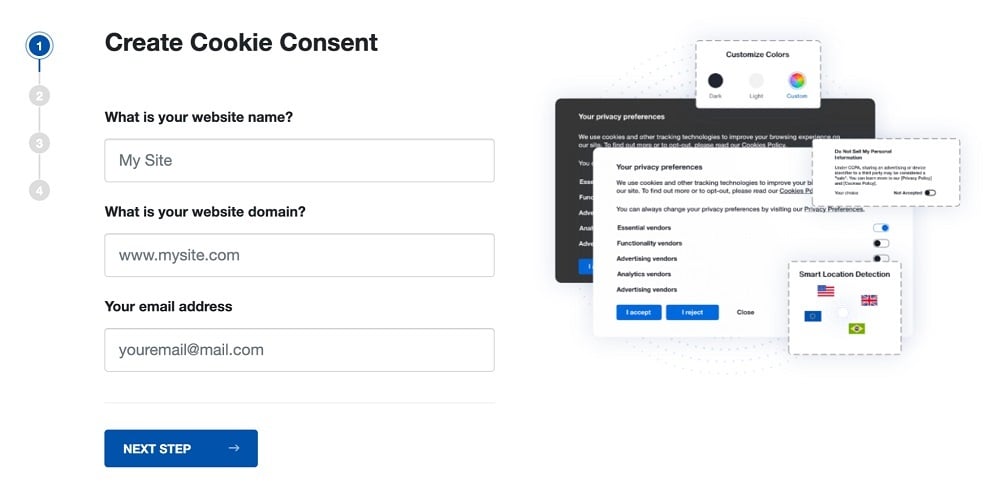
Start the Privacy Consent wizard to create the Cookie Consent code by adding your website information.
-
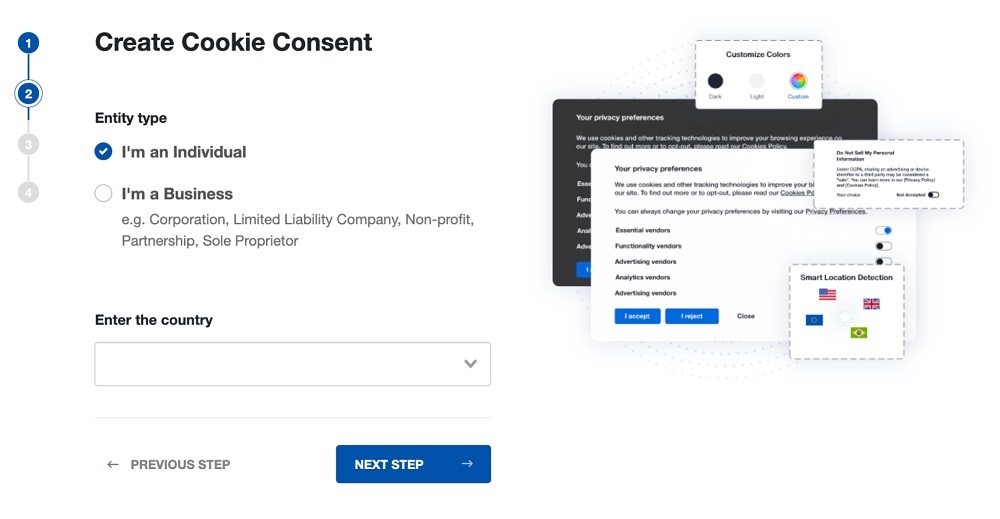
At Step 2, add in information about your business.
-
At Step 3, select a plan for the Cookie Consent.
-
You're done! Your Cookie Consent Banner is ready. Install the Cookie Consent banner on your website:
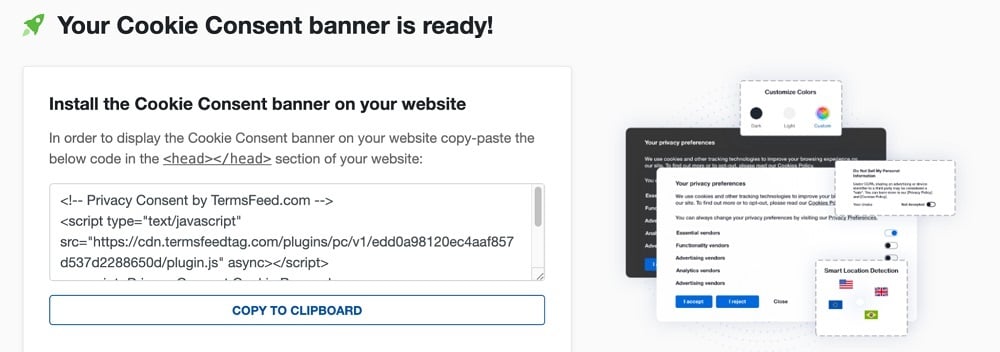
Display the Cookie Consent banner on your website by copy-paste the installation code in the
<head></head>section of your website. Instructions how to add in the code for specific platforms (WordPress, Shopify, Wix and more) are available on the Install page.


- 1. What is Osano?
- 2. What is the Osano Price?
- 3. What are the Best Osano Features?
- 3.1. 1. One-Line JavaScript Installation
- 3.2. 2. AI-Powered Cookie Scanning & Classification
- 3.3. 3. No Dark Patterns Enforcement
- 3.4. 4. $500K No-Fines Compliance Guarantee
- 3.5. 5. 95+ Regulation Coverage Across 50+ Countries
- 3.6. 6. Vendor Risk Monitoring
- 3.7. 7. Consent Logging & Audit Trail
- 3.8. 8. Customizable Branded Banners
- 3.9. 9. 45+ Language Localization
- 3.10. 10. Bulk Domain Management
- 3.11. 11. Data Subject Access Request (DSAR) Handling
- 3.12. 12. Compliance Dashboards & Reporting
- 3.13. 13. Google Consent Mode Support
- 3.14. 14. Data Mapping & Processing Records
- 3.15. 15. Policy Change Alerts
- 4. How does Osano Work?
- 4.1. What You Need Before Starting
- 4.2. Setup & Deployment Steps
- 4.3. Under the Hood: Key Mechanisms
- 4.4. Limitations & Edge Cases
- 5. What are the Pros of Osano?
- 6. What are the Cons of Osano?
- 7. What are the alternatives to Osano?
- 7.1. What is the history of Osano?
What is Osano?
Osano is an all-in-one data privacy management platform designed to simplify compliance with global data protection laws, including the General Data Protection Regulation (GDPR), the California Consumer Privacy Act (CCPA/CPRA), and more.

Osano serves as both a Consent Management Platform (CMP) and a broader privacy operations tool. A CMP controls how websites collect, store, and document consent for cookies and other tracking technologies under laws like the GDPR and the CCPA/CPRA.
Osano is notably one of the fastest-deploying consent management tools on the market. It deploys via a single line of JavaScript embedded directly in the source code of a website.

Another defining feature of Osano is its dark patterns guardrails. This means Osano actively discourages cookie consent banner designs that push users toward accepting intrusive tracking or sharing more data than they intend.
Regulatory authorities like the European Data Protection Board (EDPB) and the California Privacy Protection Agency (CPPA) increasingly penalize dark patterns and similar practices because they undermine valid consent requirements under privacy laws.
Several other attributes define the broader value of Osano in the privacy software market.
- Multi-jurisdiction compliance support: Osano supports over 95 privacy laws across 50+ countries, including the GDPR, CCPA/CPRA, and more.
- Vendor risk monitoring: Continuous monitoring through Osano helps businesses identify privacy changes and compliance risks across their third-party vendors.
- Compliance documentation: Osano offers consent logs, audit trails, Data Subject Access Request (DSAR) workflows, and data processing records to give businesses regulator-ready evidence for inquiries and investigations.
- Privacy-safe analytics and advertising support: Native support for Google Consent Mode and the IAB Transparency and Consent Framework helps businesses preserve their analytics data and advertising revenue while respecting visitor consent choices.
Osano primarily serves mid-market companies, agencies with multiple domains, and enterprises operating across jurisdictions. The platform is well-suited to teams that need deeper governance features than banner-only products but want faster deployment than enterprise tools like OneTrust.
What is the Osano Price?
The Osano price is from $199 per month on its self-service cookie consent page, scaling up depending on compliance scope and coverage. There is a free plan available for solo operators and small websites.
Osano sets its pricing plans for the cookie consent feature based on monthly visitor volume, number of domains, and access to specific compliance features. The table below summarizes the publicly available pricing structure.
| Plan | Price | Designed For | Key Limits & Features |
| Free | $0/month | Solo founders and personal websites | 1 user, 1 domain, up to 5,000 monthly visitors |
| Plus | $199/month | Small businesses and growing teams | 2 users, 3 domains, up to 30,000 monthly visitors, privacy and legal templates, GDPR/UK representative services |
| Basic Privacy | Custom pricing | Growing companies and enterprises | Unlimited users and domains, compliance monitoring, DSAR workflows, guided onboarding, dedicated support, and the $500,000 No Fines Guarantee |
The $500,000 Osano guarantee only applies to customers on the enterprise-level pricing plans. Businesses that commit to annual or multi-year agreements receive discounted pricing through direct negotiation, depending on compliance scope.
The main pricing page of Osano does not mention any specific price or pricing tier. Instead, the page directs visitors to book a demo for the broader platform.

This pricing model puts Osano near the premium end of the privacy software market when compared to alternatives. TermsFeed and CookieYes, for instance, start at $10 per month, though they do not offer some advanced governance features found in Osano.
One notable aspect of the Osano pricing structure is the gap between the Free and Plus plans. Businesses that outgrow the 5,000 monthly visitor limit move from a free tier directly to a $199 per month subscription. That jump is justifiable for businesses that need enterprise-level compliance features.
However, businesses that mainly need legal policies and consent banners often find better value in alternative platforms like TermsFeed, which offers a free plan and paid features starting at $10 per month.
What are the Best Osano Features?
The Best Osano Features are a set of 15 capabilities that span consent management, vendor monitoring, DSAR automation, compliance documentation, and privacy program operations.
Each feature addresses a specific compliance area that businesses face when navigating multi-jurisdiction privacy requirements. The following list introduces what Osano offers.
- One-Line JavaScript Installation
- AI-Powered Cookie Scanning & Classification
- No Dark Patterns Enforcement
- $500K No-Fines Compliance Guarantee
- 95+ Regulation Coverage Across 50+ Countries
- Vendor Risk Monitoring
- Consent Logging & Audit Trail
- Customizable Branded Banners
- 45+ Language Localization
- Bulk Domain Management
- Data Subject Access Request (DSAR) Handling
- Compliance Dashboards & Reporting
- Google Consent Mode Support
- Data Mapping & Processing Records
- Policy Change Alerts
The sections that follow unpack each feature in detail.
1. One-Line JavaScript Installation
One-Line JavaScript Installation is an installation method that lets businesses deploy Osano by adding a single JavaScript snippet to the <head> section of their website.
This feature addresses one of the biggest obstacles to privacy compliance: implementation complexity. While consent management tools often require extensive configuration to become operational, Osano reduces the engineering effort required to get started.
According to Osano, placing a line of JavaScript in the <head> section of a website activates core functionality, including cookie scanning, consent banner delivery, consent logging, and consent enforcement across supported technologies.

The practical benefit here is speed. Osano empowers marketing and compliance teams to move from setup to a live cookie consent banner much faster than enterprise privacy platforms.
One limitation, however, is that some websites still need additional configuration. Complex tag management setups and uncommon tracking technologies occasionally need manual review to ensure every technology follows visitor consent preferences correctly.
One-Line JavaScript Install is available on all Cookie Consent plans, including the Free plan. The feature serves as the foundation of the Osano deployment model.
2. AI-Powered Cookie Scanning & Classification
AI-Powered Cookie Scanning & Classification is an automated system that finds cookies and other tracking technologies on a website and places them into appropriate consent categories.
These categories typically include essential, analytics, functional, and marketing cookies. Compliance teams are able to manually adjust classifications for edge cases when a tracker does not fit the default rules or where the classifier gets it wrong.

Automated cookie scanning and classification help compliance teams maintain an accurate cookie inventory, especially as websites continuously add new tools and third-party scripts.
This means businesses spend less time finding new cookies and more time reviewing exceptions. One key caveat is that HTTP-only cookies and unusual implementations on Osano require manual scanning or rules to ensure cookie disclosures remain complete.
3. No Dark Patterns Enforcement
No Dark Patterns Enforcement is a built-in compliance guardrail that prevents deceptive consent designs that pressure users into accepting tracking.
Dark patterns are design techniques that steer people toward a preferred outcome through visual tricks or confusing wording. Common examples are as follows.
- Hiding "Reject" or "Decline" options when offering users choices
- Making "Accept" or "Agree" buttons more prominent
- Requiring users to take extra steps before declining tracking
- Pre-checking consent boxes to trick users into accepting certain choices
Osano constantly monitors all cookie consent banners on the platform and flags these dark patterns once detected.

In addition, Osano upholds privacy-friendly design principles with pre-built banner templates. A common example is giving "Accept" and "Reject" options equal visibility on banners (like in the example below) instead of visually emphasizing one over the other.

With Osano, compliance teams retain control over branding, messaging, and layout while avoiding many of the design decisions that attract regulatory scrutiny. However, companies that want complete control over every aspect of the consent experience find Osano more restrictive than highly customizable enterprise platforms.
4. $500K No-Fines Compliance Guarantee
$500K No-Fines Compliance Guarantee is a program under which Osano agrees to cover up to $500,000 in qualifying regulatory penalties that result from failures of the platform.
This guarantee is one of the most distinctive features in the consent management market. It is meant for users who adhere to the Osano deployment guidelines and recommended compliance workflows.
According to Osano, the coverage applies when a regulatory fine or penalty arises directly from a defect or failure in the Osano platform, subject to the Osano Terms of Service.

Privacy software vendors famously promise compliance support, yet few attach a financial commitment to those promises. Osano uses this guarantee as proof of confidence in its technology and compliance program. This provides some reassurance for companies in heavily regulated industries.
The $500,000 No-Fine Compliance Guarantee is available on the Osano Basic Privacy tier and higher custom enterprise plans. The guarantee is not included in the Free or Plus plans.
5. 95+ Regulation Coverage Across 50+ Countries
95+ Regulation Coverage Across 50+ Countries is a framework of pre-built compliance rules that Osano maintains and automatically applies based on the location of website visitors.
Osano detects where a visitor connects from and serves the correct consent and privacy experience for that jurisdiction. A user in France sees a GDPR-compliant banner with explicit opt-in requirements, while a visitor in California receives a CPRA-compliant banner with a clear opt-out option.
Osano applies this feature automatically without requiring separate configurations for each law. For instance, the image below shows the Osano consent banner preview for Italian visitors, including the language and granular choices required under the GDPR.

For Canadian visitors, however, the banner switches to English, without granular choices or consent buttons, to reflect Canadian privacy and consent standards.

Osano monitors all regulatory changes and adjusts user privacy and consent experiences automatically to help businesses remain compliant across every market they serve.
One notable limitation is that automatic coverage applies primarily to the Osano cookie consent feature. Broader compliance obligations like data protection impact assessments or processor agreements still need some manual oversight.
6. Vendor Risk Monitoring
Vendor Risk Monitoring is a continuous tracking system that assesses the privacy practices of third-party vendors and flags potential risks that affect the compliance posture of a business.
Companies typically use several external services for analytics, marketing, payments, customer support, and other key functions. Each third-party vendor poses a privacy risk because their data processing policies and security practices change over time.
Osano monitors all participating vendors (including fourth-party vendors) and notifies compliance teams when it detects risks that need review. This gives businesses greater visibility into a part of compliance that often receives little attention after onboarding.

Compliance teams get an early warning system for potential issues before they become larger governance problems. The main limitation is that monitoring does not replace vendor due diligence. Businesses still need to assess whether a change creates legal or operational risk for their specific use case.
Vendor Risk Monitoring is only available through the Osano broader privacy platform and custom plans. It is not included in the publicly listed Free or Plus Cookie Consent tiers.
7. Consent Logging & Audit Trail
Consent Logging & Audit Trail is a secure record-keeping ledger that documents every cookie consent choice made by website visitors.
This feature addresses the burden of proof requirement under privacy laws. The GDPR, for example, states that data controllers (businesses that collect and manage data) bear the obligation of demonstrating that they obtained valid consent from consumers.
A business that cannot produce structured consent records and maintain a clear audit history struggles during a regulatory inquiry. Osano provides immediate relief here by storing consent events in a central, visually appealing compliance dashboard.

Osano is unique here for using a blockchain mechanism to provide cryptographic proof that no one tampers with consent records. Compliance teams maintain secure consent logs rather than scrambling through server records when regulators ask for evidence of consent.
8. Customizable Branded Banners
Customizable Branded Banners is a design system that gives compliance teams significant visual control over their cookie consent banners while keeping compliance guardrails active.
Cookie banners often create tension between designers who want cookie consent banners to match the brand aesthetic and legal teams that need compliant consent banners.
This usually means businesses either deploy generic banners that hurt user experience or customize their way into non-compliant banner designs.
Osano removes that tradeoff by offering control over banner type, colors, duration, messaging, and placement without compromising compliance.

With this feature, website visitors see and interact with banners that feel like a natural part of the website. That said, organizations that want complete control over every design element find Osano more restrictive than enterprise platforms.
9. 45+ Language Localization
45+ Language Localization is an automated translation engine that displays cookie consent banners in the preferred language of visitors based on their browser settings or location.
Privacy Policies and other legal agreements only work when people understand them. A consent banner that displays English alone provides little value to a visitor in Italy, Germany, Japan, or Brazil if the visitor cannot easily understand the choices being presented.
Osano automatically localizes banner content in more than 45 languages for this reason. This means compliance teams provide a more consistent experience across international markets without having to build separate cookie consent banner configurations for each.
10. Bulk Domain Management
Bulk Domain Management is an organization-level control system that lets teams manage consent settings across multiple websites from a single dashboard.
Many businesses operate more than one website. Agencies often manage dozens of client properties. Large organizations regularly maintain separate websites for regions or subsidiaries. Managing consent settings individually across every domain quickly becomes difficult and error-prone.
Osano lets teams push configurations, banner updates, and policy changes across every domain under their account simultaneously. One key limitation is that some websites still require unique settings because of regional requirements or technology stacks.
Limited multi-domain management begins on the Osano Plus plan (up to 3 domains). The free support just 1 domain. Large-scale domain management and unlimited domains require the Basic Privacy tier or higher custom plans.
11. Data Subject Access Request (DSAR) Handling
Data Subject Access Request (DSAR) Handling is an automated system that helps businesses receive, track, and respond to privacy requests from individuals.
A Data Subject Access Request (DSAR) is a request from an individual to access, correct, delete, or otherwise exercise certain rights related to personal data.
Privacy laws like the GDPR and CCPA/CPRA give consumers these rights and impose deadlines for responding. The GDPR, for example, requires responses to data subject requests within 30 days, while the CCPA/CPRA sets a 45-day response window.
Osano automatically captures every request through a configurable intake form, routes it to the appropriate team member, tracks progress toward the regulatory deadline, and keeps a detailed record of all requests. A typical data subject request log within the Osano platform is shown below.

Basic DSAR workflows first appear on the Osano Basic Privacy plan. More advanced subject rights capabilities are available on the broader privacy platform and enterprise plans.
12. Compliance Dashboards & Reporting
Compliance Dashboards & Reporting is a feature that gives teams real-time visibility into consent rates, risk indicators, and compliance trends across key areas, all within the Osano dashboard.
Privacy programs tend to generate large amounts of information, including consent rates, vendor activity, request volumes, and regional compliance trends. Without consolidated reporting, businesses have to piece together data from multiple tools to understand their compliance posture.
That process is slow, error-prone, and rarely shows where risk is actually accumulating. Osano brings this information into a single dashboard, giving teams visibility into how privacy controls perform across websites and jurisdictions.

Compliance teams easily review consent trends and monitor areas that require attention for better decision-making.
The limitation is that dashboards only reflect the information collected by the platform. Effective reporting still depends on accurate configurations, complete data sources, and regular review by the team responsible for compliance.
13. Google Consent Mode Support
Google Consent Mode Support is a native integration that adjusts how Google tags behave based on the consent choices of each visitor.
This feature has become increasingly important since Google requires businesses serving ads in the European Economic Area (EEA) and the United Kingdom to use a certified Consent Management Platform (CMP) with Consent Mode v2.
Osano is a Google-certified CMP and automatically maps visitor consent choices to Google Consent Mode signals. Once a visitor accepts or declines tracking, Osano passes those preferences directly to Google Analytics, Google Ads, and other supported Google services without requiring complex manual configuration.

Native integration with Consent Mode means businesses respect consent choices while preserving valuable analytics and advertising insights.
14. Data Mapping & Processing Records
Data Mapping & Processing Records is a privacy management system that documents how personal data flows through an organization, including where it comes from, where it goes, the legal basis for processing it, and how long it is retained.
Under Article 30 of the GDPR, organizations are required to maintain a Record of Processing Activities (RoPA) and submit it to regulators upon request. Many other global privacy laws have similar provisions for RoPA documentation.
For many businesses, customer data flows through websites, CRM platforms, marketing tools, support systems, payment processors, and dozens of other applications. Tracking everything manually is nearly impossible and simply inefficient.
Osano auto-populates all relevant records using its data discovery tools and links data mapping directly to DSAR workflows and vendor risk assessments. This means the same data inventory serves multiple compliance functions simultaneously.

With the Osano data mapping feature, compliance teams respond to regulatory inquiries faster, identify unnecessary data collection practices, and assess the privacy impact of new vendors without hassle.
15. Policy Change Alerts
Policy Change Alerts is a vendor monitoring feature that tracks changes to third-party legal policies and flags updates likely to affect the compliance obligations of a business.
This feature addresses a common blind spot in privacy compliance. Businesses often rely on dozens of third-party vendors for various data processing activities. Yet, those vendors regularly update their policies on personal data, often without proper notification.

Under privacy laws like the GDPR, organizations remain responsible for many aspects of how processors handle personal data, even when the change originates with a third party.
Osano continuously monitors participating vendors for policy updates and categorizes changes by significance. Major changes trigger an attorney review of the updated policy, while minor changes are logged without escalation.
Osano then presents policy changes in a side-by-side comparison view, making it easier to see what changed and whether further action is necessary. This helps privacy teams spot potential compliance risks earlier and reassess vendors before small changes become larger governance issues.
How does Osano Work?
Osano works by pasting a single JavaScript snippet (osano.js) in the <head> section of a website. This activates the full consent management stack before any non-essential cookies run.
Once installed, Osano follows a continuous process that begins the moment a visitor loads a page. The Osano script determines which consent experience should be displayed based on visitor location and applicable privacy laws.
At the same time, Osano scans the website to identify cookies, pixels, tags, and other trackers before assigning them to defined categories (Essential, Analytics, Marketing, Personalization, etc.)
Visitors can choose which categories of tracking they wish to allow when the consent banner appears. Osano then enforces those choices across all connected technologies, ensuring that approved scripts load normally while restricted scripts remain blocked until users give their consent.
As visitors interact with the banner, each consent decision is recorded in a detailed log that organizations can use as evidence during audits or regulatory inquiries.
Osano continues running automated scans in the background to detect newly added cookies and trackers. The platform monitors vendors for changes to their Privacy Policies and updates regulatory rules as privacy requirements evolve.
The sections below explain the Osano setup process, the core mechanisms that power the platform, and the limitations teams should understand before deployment.
What You Need Before Starting
What You Need Before Starting with Osano depends on the type of website you operate, but the technical requirements are relatively lightweight compared to most enterprise privacy platforms.
Before deployment, teams typically need the following.
- An active Osano account to create and manage consent configurations.
- Access to the website header so the Osano JavaScript snippet can be installed within the
<head>section of the site. - A published Privacy Policy URL that can be linked from the consent banner. While not strictly required for installation, most privacy laws expect organizations to provide visitors with accessible privacy disclosures.
- Administrative access to analytics or advertising tools if you plan to use integrations like Google Analytics, Google Ads, or Google Consent Mode.
- A list of domains if you manage multiple websites under a single Osano account.
The simplicity of this setup is one of the primary advantages of Osano. While enterprise platforms often involve weeks of deployment and specialists, the Osano deployment process is designed around a single JavaScript installation. A standard installation takes from a few minutes to several hours, depending on the complexity of your website.
Setup & Deployment Steps
Setup & Deployment Steps cover everything needed to take Osano from account creation to a fully active consent configuration.
Below are the steps to complete the initial setup.
- Create Your Configuration Container: Log in to the Osano dashboard and create a new configuration profile. Enter the root domain name of your website, paste the link to your active Privacy Policy URL, and fill in other details as prompted.
- Customize the Look and Feel of Your Banner: Use the Osano visual editor to customize the consent banner to match your brand, including colors, layout, button labels, and placement. No coding required.
- Adjust Advanced Settings If Needed: Toggle on Global Privacy Control, Google Consent Mode, IAB TCF, and other relevant settings in the dashboard. After configuring your settings, click "Create Configuration" and then "Publish."
- Grab Your Code Snippet: Click the "Get Code" button inside your dashboard setup to copy your unique osano.js script.
- Install the Script at the Very Top of Your Website: Paste the copied script tag into the global
<head>of all pages you want to monitor. This script must be placed as the first item in your website code. Loading any other script before Osano prevents the system from properly blocking unapproved cookies and tracking tools. - Publish Your First Draft in Discovery/Listener Mode: Click the publish button to send the code live. By default, Osano automatically starts in "Discovery/Listener" mode. In this state, the platform watches and records all the cookies and scripts running on your site without blocking anything or displaying a banner to visitors.
- Classify Your Discovered Cookies and Scripts: Go to the Cookies tab in your dashboard to see what the listener mode discovered. Group each cookie into its proper category (Essential, Analytics, etc.). Osano uses AI to suggest categories, but you can manually change them if needed.
- Go Live with Permissive or Strict Mode: Once you classify every cookie, publish the configuration in permissive or strict mode. In Permissive mode, categorized cookies load or block based on user choice, while uncategorized cookies are still allowed to run. Strict mode blocks all uncategorized cookies until you review and classify them. Osano recommends strict mode for the highest level of privacy compliance.
To verify the full setup, test that the banner displays correctly across regions like the EU and US through a VPN. Confirm that consent records appear in the dashboard, and test key analytics or advertising integrations to ensure consent signals are being passed correctly.
Under the Hood: Key Mechanisms
Under the Hood: Key Mechanisms runs 3 core systems that connect to deliver a complete consent enforcement system.
- Script interception: The osano.js file must load first in the
<head>of the website. Every script that loads after it falls within the reach of the Osano classifier. In Strict mode, Osano holds all non-essential scripts until the visitor makes a consent choice. The moment a visitor accepts or declines, Osano fires or suppresses the relevant scripts accordingly and logs the event with a timestamp and banner version. - Geo-aware banner delivery: Osano detects visitor location and applies the correct compliance mode automatically. A visitor from Germany receives a GDPR opt-in banner. A California visitor receives a CPRA-compliant opt-out experience. The rule sets behind each jurisdiction update automatically as regulations change.
- Consent signal propagation: Consent choices pass directly to Google tags via Google Consent Mode v2 parameters, ensuring analytics and advertising tools adjust data collection behavior in real time without additional configuration.
Limitations & Edge Cases
Limitations & Edge Cases cover the documented scenarios where Osano behaves unexpectedly or requires additional manual configuration beyond the standard setup.
- HTTP-only Cookies: The Osano AI scanner works at the JavaScript layer and cannot automatically discover or classify HTTP-only cookies. Teams need to configure manual scanning rules to bring those cookies into the consent management workflow.
- Server-side Cookies: Osano cannot discover or block server-side cookies by default, as confirmed in the Osano developer documentation. Teams relying on server-side tracking need to use the Cookie Consent API to read consent preferences and enforce them at the server level manually.
- Script Load Order Conflicts: Osano blocks scripts that load after it. Native CMS integrations (Google Analytics added through the Webflow Integrations tab or Shopify built-in marketing tools) often load before osano.js regardless of where the script appears in the page settings. Those scripts require manual relocation into custom code sections to respect consent enforcement.
- Unclassified Vendor Script Changes: A vendor updating their tracking script generates a new URL that Osano treats as unclassified and blocks immediately in "Strict Mode." Marketing teams lose tracking data until the new script gets reviewed and reclassified. This is a gap that Osano recommends treating as a recurring item in the standard release schedule.
What are the Pros of Osano?
The Pros of Osano are a combination of deployment speed, financial backing, compliance-first design, and multi-jurisdiction coverage that sets the platform apart in the mid-market consent management space.
Most reviewers consistently highlight the following strengths.
- Fast deployment compared to enterprise platforms: Most teams launch Osano by installing a single JavaScript snippet rather than completing lengthy implementation projects involving developers and multiple system integrations.
- A unique $500,000 No-fines guarantee: No direct Osano competitor offers financial coverage for regulatory fines caused by a platform failure. The Osano guarantee covers up to $500,000 for users on the Basic Privacy tier and shows a rare accountability standard in the consent management space.
- Compliance guardrails are built into the product: Osano actively discourages dark patterns by promoting balanced consent choices and privacy-first banner designs rather than leaving compliance entirely to administrators.
- Automated cookie discovery: Continuous scanning and AI-assisted classification help teams maintain an accurate cookie inventory as websites evolve over time.
- Strong US state privacy law coverage: Osano covers the CCPA/CPRA, the Virginia Consumer Data Protection Act (VCDPA), the Colorado Privacy Act (CPA), the Connecticut Data Privacy Act (CTDPA), and more than 95 regulations globally. This wide scope suits US-based businesses managing multiple state-level compliance obligations simultaneously.
- Vendor risk monitoring: Most consent-only tools stop at cookie banners. Osano monitors the Privacy Policies of more than 11,000 vendors and flags material changes. This gives businesses visibility into third-party risk that cookie management alone does not provide.
- Clean, intuitive interface: Across G2, SoftwareFinder, and TrustRadius, user reviews consistently highlight the clean dashboard, straightforward workflows, and relatively low learning curve of Osano compared to larger enterprise platforms.
What are the Cons of Osano?
The Cons of Osano are its price point, a limited free tier, fewer CMS integrations than key competitors, and a lack of enterprise-level customization.
The Osano disadvantages below paint a picture of where the platform falls short.
- Pricing starts at $199 per month: The $199 Plus plan is the entry point for paid features, including cookie blocking and consent logging. For low-traffic sites and solo operators, this price is difficult to justify against competitors like Termsfeed, which starts from $10 per month, or Secure Privacy, which starts from $15 per month.
- The free tier is intentionally limited: Free Osano users receive basic consent management, but advanced compliance capabilities like subject rights workflows and broader privacy tooling require paid plans. The free plan displays cookie information but does not block non-consented trackers or log consent events.
- Fewer CMS-specific integrations: Competitors like Cookiebot and CookieYes offer a wider selection of dedicated CMS integrations and ecosystem-specific deployment options. For example, Cookiebot and CookieYes both offer native WordPress plugins that make installation a fast process for most websites globally.
- HTTP-only cookies require manual setup: The Osano AI scanner works at the JavaScript layer and does not automatically discover cookies set by servers through HTTP response headers. Teams using server-side tracking need to add manual scanning rules to bring those cookies into the consent workflow.
- Less granular customization than enterprise platforms: Osano prioritizes compliant defaults and guardrails, which can feel restrictive for organizations that want complete control over banner behavior and consent flows.
- Smaller community and ecosystem: Osano has a growing customer base but lacks the extensive partner network, training resources, and implementation community of enterprise privacy platforms like OneTrust.
- No dedicated Shopify or WooCommerce plugins: Ecommerce businesses running on Shopify or WooCommerce must integrate Osano through the one-line JavaScript snippet rather than a purpose-built plugin.
What are the alternatives to Osano?
The alternatives to Osano are privacy platforms that range from lightweight consent tools for small businesses to enterprise governance platforms for global organizations.
- TermsFeed: A lightweight privacy compliance platform focused on attorney-reviewed legal documents and consent solutions. TermsFeed delivers Privacy Policies, Terms and Conditions, and cookie consent tools as one-time purchases or affordable subscriptions starting at $10 per month. The platform suits small businesses and solo operators that need straightforward legal compliance.
- OneTrust: An enterprise-grade governance platform covering privacy, security, data governance, and AI compliance. OneTrust offers deep configurability, nearly 500 integrations, and a cookie database with over 45 million pre-categorized entries. Pricing follows a custom, quote-based model starting around $10,000 per year, which positions it firmly in the enterprise segment.
- Cookiebot: A mid-range CMP known for its patented cookie scanner and wide CMS plugin support. Cookiebot integrates natively with WordPress, Shopify, and other major platforms. The scanner technology is among the most mature in the category, and the platform supports IAB TCF v2.2 and Google Consent Mode.
- Secure Privacy: A budget-friendly consent management platform starting at $15 per month with coverage for 55+ data privacy laws. Secure Privacy offers cookie scanning, consent logging, and multi-language support at a price point accessible to small and mid-sized businesses.
- CookieYes: A CMP with a generous free tier that supports up to 100 pages per domain. CookieYes includes cookie scanning, consent logging, and multi-language support on the free plan, which makes it a practical entry point for small sites needing basic compliance.
- Enzuzo: A Shopify-native privacy platform with multi-domain support and a free plan available. Enzuzo offers cookie consent, legal policy generation, and DSAR handling with a focus on ecommerce use cases. The Shopify integration is purpose-built rather than adapted from a generic solution.
What is the history of Osano?
The history of Osano traces back to 2018, when 2 entrepreneurs watched U.S. lawmakers struggle to understand data privacy on live television and decided to build the compliance company they always wished existed.
The following timeline covers the key moments in the development of Osano from its founding to its current position as a mid-market data privacy platform.
- October 2018: Arlo Gilbert and Scott Hertel co-founded Osano in Austin, Texas, as a B Corporation, following the sale of their previous company. The founding mission was to make data privacy accessible to businesses of all sizes.
- March 2019: Osano raises $3 million in seed funding and launches Privacy Monitor, a free browser extension that scores the privacy practices of third-party vendors.
- October 2019: Osano enters the TechCrunch Disrupt Battlefield and builds early brand recognition in the compliance space.
- December 2019: Osano closes a $5.4 million Series A round, co-led by LiveOak Venture Partners and NextCoast Ventures, bringing total funding to $8.4 million.
- 2020 to 2022: Osano expands beyond cookie consent into vendor risk monitoring, Data Subject Request (DSR) handling, data mapping, and privacy assessment workflows.
- September 2021: Osano raises $11 million in its Series A funding round led by Jump Capital with participation from TDF Ventures and other existing investors. The "No Fines, No Penalties" guarantee launches as a core differentiator.
- August 2023: Osano closes a $25 million Series B round led by Baird Capital, with participation from Jump Capital, LiveOak Venture Partners, NextCoast Ventures, TDF Ventures, and First Ascent Ventures. Katharine Tomko, former Head of Privacy Programs at Facebook, joins as a Board Observer.
Osano currently operates as a remote company and processes more than 1 billion consent events per month. The total funding Osano raised across 4 rounds stands at $44.4 million. G2 recognizes the platform as a Leader in consent management and a Momentum Leader in data privacy management.

The first step to compliance: A Privacy Policy.
Stay compliant with our agreements, policies, and consent banners — everything you need, all in one place.


