


AI Summarize


Share


Ketch is a consent management platform (CMP) that helps businesses collect, manage, and enforce user data consent to ensure privacy compliance.
Looking for Ketch reviews? This is a Ketch review article that covers features such as progressive consent, data subject request (DSR) automation, and data mapping, along with support for 1,000+ integrations. It breaks down pricing (Ketch software is free for businesses with up to 5,000 users per month with paid plans starting at $150/month) and explains pros, like an intuitive, no-code interface, and cons, such as a learning curve in the admin dashboard during initial setup, to help you decide if the Ketch tool is right for you.
- 1. What is Ketch?
- 2. What is the Ketch Price?
- 3. What are the Best Ketch Features?
- 3.1. 1. Progressive Consent
- 3.2. 2. DSR Automation
- 3.3. 3. Ketch Identity Sync
- 3.4. 4. AI-Powered Data Mapping & Discovery
- 3.5. 5. Data Sentry (Privacy Pentest)
- 3.6. 6. Orchestration Engine
- 3.7. 7. Privacy 360 Analytics Suite
- 3.8. 8. Marketing Preference Management
- 3.9. 9. Risk Assessments & Reporting
- 3.10. 10. AI Governance
- 3.11. 11. Automated Regulatory Updates
- 3.12. 12. Tag Orchestration & Cookie Scanning
- 3.13. 13. 1,000+ Pre-Built Integrations
- 3.14. 14. Mobile SDKs
- 4. How does Ketch Tool Work?
- 4.1. Prerequisites & Components
- 4.2. Step-by-Step Process Flow
- 4.3. Key Mechanisms Explained
- 4.4. Edge Cases & Failure Modes
- 5. What Are the Pros and Cons of Ketch?
- 5.1. What are the Pros of Ketch?
- 5.2. What are the Cons of Ketch?
- 6. What are the alternatives to Ketch?
- 6.1. What is the History of Ketch?
What is Ketch?
Ketch is modern privacy management software that helps brands collect, control, and use permissioned data in compliance with privacy laws.
Wondering what is Ketch? Ketch is a data permissioning platform that helps businesses manage consent across systems. It goes beyond basic cookie consent by offering features such as DSR automation, real-time data mapping, and Artificial Intelligence (AI) governance capabilities.
Key characteristics of the Ketch tool include:
- Application Programming Interface (API)-first architecture that supports flexible integration across systems
- No-code interface that enables non-technical users to manage consent
- Founded by the entrepreneurs behind Krux and Rapt
Ketch is designed for mid-market to enterprise organizations, particularly legal, privacy, and marketing teams building responsible first-party data strategies, with use across industries including tech, media, retail, financial services, and healthcare.
What is the Ketch Price?
The Ketch price is dependent on the plan you choose, with plans ranging from $0 to $499/month, plus custom enterprise pricing.
Ketch does have a 30-day free trial, but after that, you'll be required to upgrade if your visitor count exceeds the Free plan limit.
All plans include consent management. Higher tiers add full DSR automation and data mapping.
Ketch pricing tiers include:
- Free: The Free plan is $0 for up to 5,000 users/month. It includes features such as a consent experience designer, preference center, and law templates, as well as 2 integrations.
- Starter: The Starter plan is $150/mo for up to 30,000 users/month.
- Plus: The Plus plan starts at $499/mo (billed annually) for up to 100,000 users/month. It includes everything on the Starter plan plus a live onboarding call and access to add-ons and 1,000+ integrations.
- Pro: The Pro plan offers custom pricing for unlimited users. It includes everything on the Plus plan, plus full DSR automation, data mapping, risk assessments, marketing preference management, and enterprise add-ons such as developer tools and unlimited customer support.
Ketch products are available à la carte, but users must contact the sales team to get pricing for individual products.

Is Ketch worth it? The Ketch cost is worth it for:
- Businesses that need a genuinely functional free CMP
- Enterprise-level organizations that want a modern consent and data permissioning infrastructure rather than a basic cookie tool
- Companies that value transparent, scalable pricing
However, Ketch pricing is based on the number of monthly unique website or mobile app visitors, which opens the door to budget unpredictability for growing sites, and some advanced features are only available on higher-tier plans. Businesses with simpler needs or tighter budgets find lighter CMP tools more cost-effective.
Keep in mind that you'll need a company email address to sign up for a Ketch plan.
What are the Best Ketch Features?
The best Ketch features are progressive consent, DSR automation, and data mapping.
Ketch features include:
- Progressive consent. One of the top Ketch capabilities is progressive consent, which collects consent based on context. This reduces disruptions and improves opt-in rates by prompting users at relevant moments, such as asking a visitor who arrives via Facebook whether they want to receive ads on their social media channels.
- DSR automation. Automates responses to data subject requests such as access, deletion, or correction of personal data, helping speed up compliance processes and ensure individuals receive timely responses to their requests.
- Ketch identity sync. Synchronizes user identity and consent preferences across devices and systems, helping ensure consistent enforcement of user choices, whether they're on a website, app, or logged into different sessions.
- AI-Powered data mapping & discovery. Uses AI to automatically map where personal data exists across systems, reducing manual effort and helping ensure user data is properly tracked and managed.
- Data Sentry (Privacy Pentest). Scans digital properties to identify privacy risks, such as unauthorized trackers or misconfigured settings, helping organizations fix issues and protect user data.
- Orchestration engine. Helps organizations automatically apply customer privacy choices across systems, reducing manual work and making compliance easier.
- Privacy 360 analytics suite. Tracks user consent and privacy preferences, enabling businesses to monitor, enforce, and demonstrate compliance with regulations like the European Union (EU) General Data Protection Regulation (GDPR).
- Marketing preference management. Automatically collects and enforces user communication preferences across systems, helping businesses manage first-party data responsibly, reduce unsubscribes, and build trust through transparency.
- Risk assessments & reporting. Helps businesses create and manage privacy assessments using templates and connected data, reducing manual work and improving compliance.
- AI governance. Enforces how data is used across models and tools, helping ensure that personal data used in AI systems honors user consent preferences and follows privacy rules.
- Automated regulatory updates. Keeps privacy compliance templates current as laws evolve, reducing the need for manual tracking and updates.
- Tag orchestration & cookie scanning. Helps businesses identify and control tracking technologies, ensuring they operate based on user consent.
- 1,000+ pre-built integrations. Offers integrations with customer relationship management (CRM), analytics, and marketing systems, allowing organizations to extend privacy controls across their entire tech stack.
- Mobile Software Development Kits (SDKs). Enable organizations to collect and manage user consent within mobile apps, helping to ensure consistent privacy controls and compliance across both mobile and web environments.
1. Progressive Consent
Progressive consent is a Ketch feature that enables businesses to request user consent contextually over time rather than relying on a single upfront prompt.
Ketch progressive consent is integrated into the digital experience so that consent requests appear when they are most relevant. It allows consent experiences to be customized based on factors such as user behavior, location, and data use, rather than relying on a one-size-fits-all pop-up at first visit.
Progressive consent is valuable because it reduces disruption and aligns consent prompts with user actions. By asking for consent in context, such as when a user begins interacting with a feature that requires specific data, businesses increase opt-in rates, which means more usable first-party data for marketing and analytics.
For example, instead of providing a consent banner when a user first arrives on a page, consent for marketing cookies is requested when the user starts browsing product pages.
With progressive consent, a user is presented with a consent request for personalized ads before checkout.

Customizable privacy experiences are available on all Ketch plans.
2. DSR Automation
DSR automation is a Ketch feature that enables businesses to automate data subject access requests from submission to resolution.
Ketch DSR automation is designed to replace manual, email-based request handling with automated workflows. Its no-code, drag-and-drop workflow builder enables teams to design end-to-end request flows. These workflows support request types such as access, deletion, or modification.
Businesses benefit from DSR automation by reducing privacy team workload (Ketch claims a 90% reduction in setup time) and improving consistency in handling requests. The system automates tasks including request intake, identity verification, data retrieval, and response tracking.
For example, when a consumer submits a deletion request through a company's privacy center, Ketch automatically verifies identity, locates relevant data across connected systems, and routes the request through an automated process. It then triggers deletion actions across integrated systems to support privacy law compliance.
DSR automation includes the Ketch Rights Queue, which enables businesses to monitor the real-time status of each request.

DSR automation is an add-on for Plus plan users and is fully included only on Pro plans.
3. Ketch Identity Sync
Ketch identity sync is an identity management feature that helps ensure user privacy choices are honored across platforms.
This feature connects and unifies the many identifiers associated with a user (such as cookies, device IDs, and emails) into a single profile across systems and devices. This allows businesses to manage consent and privacy preferences consistently across web, mobile, and other platforms, helping ensure that a user's choices are honored wherever they interact.
This benefits marketing and privacy teams by reducing compliance risk. It improves user experience by eliminating repeated consent prompts and builds user trust by ensuring privacy choices are respected across devices and platforms.
For example, a user opts out of receiving marketing advertisements on their phone; when they visit the same site on their laptop, that preference is recognized and enforced.
Ketch identity sync provides real-time data synchronization so that privacy signals are applied immediately across all systems.

Identity management capabilities depend on the plan:
- Free and Starter Plans: Include basic identity resolution, connecting customer consent and preferences to a single profile for smaller teams.
- Plus Plan: Adds identity mapping and data unification, helping connect data across marketing, CRM, and analytics tools.
- Pro Plan: Delivers advanced identity graphing, cross-device recognition, and real-time updates for enterprise-level privacy management.
4. AI-Powered Data Mapping & Discovery
AI-powered data mapping & discovery is a Ketch feature that helps businesses automatically identify, categorize, and map where personal data exists across their systems.
Ketch AI-powered data mapping tool scans and classifies personal data across 400+ platforms, providing visibility into how data is collected, stored, and shared across the organization.
Data mapping is valuable because it:
- Reduces the manual effort required to build and maintain data inventories and keeps data maps updated
- Helps organizations stay compliant with privacy laws like the GDPR that require maintaining records of processing activities (ROPA)
- Supports privacy risk assessments and DSR workflows
For example, data mapping connects customer information from a CRM system to a marketing platform. Customer details such as names, email addresses, and purchase history in the CRM are matched to corresponding fields in the marketing tool, ensuring accurate data transfer for campaigns, personalization, and analysis.
Only the Pro plan includes data mapping. Teams already running a CMP have the option to buy data mapping as a standalone solution.
5. Data Sentry (Privacy Pentest)
Data Sentry (Privacy Pentest) is a Ketch capability that helps organizations identify privacy risks on their websites by analyzing how data is collected, shared, and transmitted across third-party tools.
Ketch Data Sentry helps discover potential privacy vulnerabilities on websites that traditional cookie scanning misses–such as misconfigured CMPs, improper handling of opt-outs, and unauthorized data transfers to third parties–providing real-time risk classification.
Data Sentry is valuable because it helps privacy and security teams identify and fix privacy issues before regulators or users discover them. Proactive privacy monitoring reduces compliance risk by identifying issues early rather than reacting to periodic audits or regulatory investigations.
For example, Data Sentry detects a third-party chat widget that is continuing to send user data to external servers even after a user has opted out, highlighting a potential compliance issue.
Data Sentry helps businesses discover potential privacy problems by identifying unauthorized trackers and misconfigured scripts instantly.

Customers must contact Ketch to add Data Sentry to their plan.
6. Orchestration Engine
Orchestration Engine is a privacy automation capability that captures and manages consent and privacy preferences, then automatically enforces those choices across the tech stack of an organization, including ad platforms, CRMs, analytics tools, data warehouses, tag managers, and AI systems.
This feature is valuable because it helps businesses manage privacy at scale by reducing manual work and making data practices more consistent across systems, as a user's consent choice automatically flows through connected tools like Google, Meta, LinkedIn, Snowflake, Salesforce, and HubSpot.
For example, a customer withdraws consent to receive marketing materials. Their request is then communicated across connected systems so that they are removed from email marketing audiences, ad targeting lists, and analytics segments.
The number of integrations available depends on the plan: The Free, Starter, and Plus plans include 2 integrations. The Pro plan unlocks unlimited integrations. Plus plans access the 1,000+ integration library as a paid add-on.
7. Privacy 360 Analytics Suite
Privacy 360 Analytics Suite is a suite of reporting and analytics tools that gives businesses insight into how consent and user preferences are collected, managed, and applied across their data systems.
The Ketch Privacy 360 Analytics Suite provides a unified view of user consent, preferences, and privacy rights across touchpoints, tracking how decisions are made, applied across systems, and enforced over time. It connects consent data into an individual-level permission trail and helps businesses generate compliance reports, track trends, and identify inconsistencies in how data rights are applied.
This is valuable because it consolidates privacy-related metrics for reporting and monitoring and helps organizations demonstrate compliance with privacy laws like the GDPR, which require detailed consent records.
For example, a company generates a report showing consent rates by region over the past 12 months to demonstrate to auditors that data subject requests and opt-out actions were processed and fulfilled within required timeframes.
Only the Pro plan includes the Privacy 360 Analytics Suite.
8. Marketing Preference Management
Marketing preference management is a feature that automatically captures user marketing preferences and ensures they are applied consistently across websites, apps, and systems.
Ketch marketing preference management communicates customer data preferences to businesses, enabling them to collect and enforce user marketing communication choices, including product, frequency, and channel preferences.
This feature helps organizations capture first-party data responsibility, enforce preferences across the entire marketing ecosystem, and reduce unsubscribes by giving granular control.
Marketing preference management helps build trust with users by providing transparency about how businesses use their data and giving customers control over their marketing communications.
For example, a preference center lets users choose which content categories they want to receive information about and their preferred communication channels.

Marketing preference management is only included on the Pro plan.
9. Risk Assessments & Reporting
Risk assessments & reporting is a feature that helps organizations create and manage privacy impact assessments by providing pre-populated privacy assessment templates and connecting directly to data systems.
Ketch privacy assessment templates include:
- Data Protection Impact Assessment (DPIA): A DPIA is required by the GDPR for high-risk data processing. It helps organizations identify and minimize privacy risks before processing personal data.
- Privacy Impact Assessment (PIA): A PIA is a privacy review that helps businesses understand how a project or system affects personal data. It is often used as a best practice, but not necessarily legally required.
- Transfer Impact Assessment (TIA): A TIA evaluates the risks of transferring data to another country and supports compliance with the GDPR.
Ketch risk assessments & reporting provides built-in templates for DPIAs, PIAs, and TIAs, along with data from connected systems and collaboration tools.
This feature is valuable because it streamlines the assessment process by incorporating relevant data and reducing reliance on manual documentation, spreadsheets, and email chains.
Businesses benefit from faster completion of privacy assessments, standardized methodology across assessments, and a built-in audit trail.
For example, when launching a new AI feature, a company creates a DPIA workflow that pulls data from connected sources and assigns template questions to a privacy team for completion as part of the risk assessment process.
Ketch enables organizations to assign privacy assessment template questions to an individual or a team.

Risk assessments are only available on Pro plans.
10. AI Governance
AI governance is a data permissioning capability that helps ensure personal data used in AI systems honors user consent and privacy preferences.
Ketch AI governance enables businesses to control and enforce how personal data is used across AI systems, including models, agents, and data workflows. It allows teams to define rules for data use, extending consent and privacy controls into AI environments.
AI governance is valuable because it helps organizations address concerns about personal data in AI model training and prepare for emerging AI-related privacy expectations and regulations. It supports responsible data use as AI adoption increases across industries.
Businesses benefit from AI governance as it helps to ensure AI systems only use data in ways that are consistent with user permissions and organizational policies.
For example, a company using customer data to improve a recommendation model applies governance rules to ensure that only data from users who have provided consent is used in model training.
AI governance is an add-on that is not included in any of the plans.
11. Automated Regulatory Updates
Automated regulatory updates are a Ketch capability that keeps privacy compliance templates up-to-date as privacy laws evolve.
Ketch automated regulatory updates keep privacy law templates current as new regulations are enacted, reducing the need for manual tracking and updates. These updates are applied within the platform without requiring developer involvement.
This feature is valuable because state and global privacy laws are constantly evolving, and manually tracking and implementing these changes across systems is complex and time-consuming.
For example, when a new US state privacy law takes effect, Ketch automatically updates the user interface with a template for that law.
Plus and Pro plans include automated regulatory updates.
12. Tag Orchestration & Cookie Scanning
Tag orchestration & cookie scanning are Ketch capabilities that help organizations manage and control tracking technologies on their websites by identifying, categorizing, and governing cookies, pixels, and other scripts.
Ketch tag orchestration controls when tracking tags fire across a website or app based on user consent and privacy preferences, helping ensure consistent enforcement of data permission rules. Cookie scanning helps discover and categorize cookies, pixels, and scripts (including dormant trackers), and provides visibility into how tracking tools are used across a site.
These capabilities are valuable because they support compliance with privacy laws like the GDPR, the EU ePrivacy Directive, and the California Consumer Privacy Act (CCPA), which require transparency around data collection and user consent for certain tracking technologies. They help ensure marketing and analytics tags operate in accordance with user consent and reduce time spent classifying and managing cookies.
For example, a scan identifies a Facebook pixel that is still active on a website even after being removed from a tag manager, enabling teams to remove unauthorized tracking tools and prevent data from being collected without proper consent.
Website tracker scanning and tag orchestration are available on all plans.
13. 1,000+ Pre-Built Integrations
1,000+ pre-built integrations are Ketch capabilities that connect the platform to a wide range of systems, supporting accurate data mapping and consistent enforcement of privacy preferences across the tech stack of an organization.
Ketch 1,000+ pre-built integrations enable organizations to enforce consent and privacy signals across connected systems, helping extend data permissioning beyond the point of collection into downstream tools and platforms.
Ketch connects with systems including:
- Marketing platforms
- Analytics tools
- Customer Data Platforms (CDP)
- CRMs
- Cloud infrastructure
- Tag managers
- Custom apps
These integrations are valuable because effective consent enforcement depends on how broadly privacy choices are applied across the technology stack. By connecting to commonly used systems, Ketch helps ensure that user preferences are reflected consistently across marketing, analytics, and data infrastructure.
Businesses benefit by reducing the need for custom integrations and by enabling privacy and consent signals to be shared with systems such as Snowflake, Salesforce, HubSpot, Google, Facebook, and LinkedIn.
For example, an organization connects Ketch to its data warehouse and marketing platform so that when a user updates their consent preferences, those changes are automatically applied across systems.
The Free, Starter, and Plus plans include 2 integrations; additional integrations are available as add-ons for Plus plan users. Pro plan provides access to unlimited integrations.
14. Mobile SDKs
Mobile SDKs are Ketch capabilities for iOS, Android, and React that enable organizations to collect and manage user consent directly within mobile apps, helping ensure consistent privacy experiences across mobile and web environments.
Ketch mobile SDKs enable in-app consent management and integrate with broader privacy processes, including support for account deletion request flows.
Mobile SDKs are valuable because they help organizations comply with mobile app platform and privacy law requirements. Platforms like Apple and Google require developers to clearly disclose data practices, while privacy laws like the GDPR and the CCPA require organizations to provide ways for users to exercise their privacy rights and control how their personal data is used.
Businesses benefit from the ability to manage consent consistently across web and mobile applications through a unified platform. When used with identity sync capabilities, mobile consent preferences are connected to broader customer profiles so preferences are applied across systems where data is used.
For example, an e-commerce app asks users to set their privacy preferences when they first download the app. Those preferences are linked to the user's profile and then applied across the company's website and other digital properties.
Keep in mind that setting up and customizing a mobile SDK presents challenges, depending on how your app is built and how it connects to other systems, and users have reported issues with Ketch mobile SDKs.
All plans allow businesses to use mobile SDKs to add privacy banners and preference centers directly into their mobile apps and reflect updates made in the platform.
How does Ketch Tool Work?
Ketch tool works by linking users, websites, apps, and backend systems to manage data permissions and privacy controls.
Wondering how to use Ketch? It is designed to be used primarily through APIs and provides no-code configuration, making it suitable for both developers and non-technical users.
How Ketch works step-by-step:
- Deploys a lightweight JavaScript tag (for web) or SDK (for mobile apps)
- Determines the geolocation of a visitor
- Displays a region-appropriate consent banner
- Collects user preferences
- Enforces those preferences across connected systems
- Logs consent activity for audit and compliance reporting
Key mechanisms include:
- Orchestration Engine: Distributes and enforces consent signals across connected systems (marketing, analytics, data warehouses, etc.).
- Identity Sync: Connects consent and preference data to user identities across devices and sessions.
- Data Sentry: Identifies privacy risks, such as misconfigured CMPs or unauthorized data transfers.
Prerequisites include a Ketch account and access to your organization's website or app.
Prerequisites & Components
Prerequisites & components include a Ketch account, the ability to implement the CMP on your website or mobile app, a web tag or mobile SDK to capture consent, no-code consent configuration tools, and integrations to connect with other tools and platforms.
Together, these components work as a connected system: the tag or SDK collects consent at the point of interaction, the platform stores and manages those preferences, and integrations pass consent signals to other tools (such as analytics, marketing, and data systems) so user choices are consistently applied across the organization's digital ecosystem.
Step-by-Step Process Flow
Step-by-step process flow of Ketch starts with a Ketch account and domain verification.
To get started, follow these installation steps:
- Deploy a lightweight JavaScript tag.
- Configure the consent experience in the no-code editor.
- Connect integrations.
- Test the setup.
- Go live.
Once Ketch is installed, configure the software by setting and adjusting:
- Geo-targeting rules to apply region-specific privacy experiences
- Consent categories (what types of data users opt into or out of)
- Preference center branding, including layout, colors, and messaging
- DSR workflows for handling user privacy requests
Finally, you'll want to test to make sure the tool is functioning properly by testing consent flows across different regions and privacy scenarios and verifying that consent decisions are correctly enforced in connected systems.
Note that deployment time varies depending on the complexity of your business and takes a few weeks to complete.
Key Mechanisms Explained
Key mechanisms explained: Ketch works by capturing user consent on websites and apps and then managing and applying those preferences across connected systems.
First, a web tag or mobile SDK collects consent, which is then stored on the platform. Integrations pass consent signals to connected tools, such as analytics and marketing tools. Additional features like Identity Sync help associate consent with user profiles across devices and sessions.
These components work together to ensure that consent is consistently collected, stored, and enforced across an organization's digital properties, helping ensure compliance with privacy laws.
Edge Cases & Failure Modes
Edge cases & failure modes include issues with implementation on mobile platforms, SDK bugs, a steep learning curve for non-technical users, and hidden issues that only show up after testing.
Mobile apps require different setup steps, and mistakes during implementation or issues with the mobile SDK prevent Ketch from working properly.
It takes time for some users to learn the system, and problems like settings not applying as expected only surface during testing or once the tool is live. Some configurations require developer involvement, delaying full implementation.
What Are the Pros and Cons of Ketch?
The pros and cons of Ketch include a user-friendly interface for basic use cases, but a steeper learning curve for non-technical users or teams with more complex needs.
| Pros | Cons |
| Easy to use | Learning curve |
| Fast deployment | Integration gaps |
| Compliance automation | Lower-tier plan limitations |
| Real-time data control | Cost concerns |
What are the Pros of Ketch?
The pros of Ketch are an intuitive user interface, no-code tools, and fast implementation.
Ketch pros include:
- Intuitive, modern user interface. One of the main Ketch benefits is its ease of navigation for basic use cases. Once teams understand how the platform works, the interface is intuitive and easy to use, enabling faster onboarding and less reliance on technical teams.
- No coding required for policy and consent configuration. Another one of the Ketch advantages is that it offers no-code consent banners and legal policy templates. This allows non-technical users to launch and update compliance setups quickly.
- Fast implementation (weeks, not months). Ketch is designed for rapid deployment, with many implementations completed in weeks, depending on complexity. Faster setup helps reduce the risk of operational disruption due to noncompliance.
- Excellent customer support and implementation team. Users report quick, responsive customer service, which supports smoother rollouts and fewer implementation errors.
- Strong consent orchestration across tech stack. The ability to reliably apply user privacy preferences across all company tools helps ensure consistent data handling and reduce compliance risk.
- Enterprise-ready consent and preference management. Ketch supports consent and preference controls for large organizations with complex privacy requirements. Enterprise add-ons like custom identifiers, webhooks, and authenticators help enterprises manage consent data and comply with privacy laws.
- Data subject access request (DSAR) automation dramatically reduces privacy team workload. Automating data subject requests cuts down on manual processing time, freeing organizations to focus on activities like risk management and compliance strategy.
- Transparent, competitive pricing vs. legacy platforms. Ketch offers more upfront pricing compared to some older vendors that use more complex or variable pricing models. This helps organizations better manage budgets and avoid unexpected expenses.
- Developer-friendly API-first architecture. API-first design enables easier integration with existing systems and workflows, allowing developers to build and customize privacy functionality more quickly.
- Automated regulatory compliance across dozens of frameworks. Ketch continuously updates templates to reflect evolving global privacy laws, reducing reliance on constant legal monitoring.
- Deep integrations propagate consent changes in real-time. Integrations with major platforms ensure that user consent updates are reflected across systems, supporting consistent enforcement of user preferences.
- Live data mapping provides actionable privacy insights. Real-time data mapping provides insights about personal data, helping organizations identify and respond to privacy risks more effectively.
- Lightweight tag with minimal site performance impact. Ketch is designed to load quickly without slowing down websites, helping maintain fast, responsive site performance.
- Google CMP silver partner certified. Recognition from Google indicates alignment with Google consent and advertising standards and ensures compatibility with Google tools.
- Strong analyst recognition (Gartner, Forrester, IDC). Recognition from firms like Gartner, Forrester, and IDC supports Ketch's market credibility. This reassures buyers that the platform is competitive and trusted in the industry.
- Functional free tier for small businesses. The Free plan allows smaller or budget-constrained organizations to access core privacy tools. This lowers the barrier to entry and helps startups achieve compliance.
What are the Cons of Ketch?
The cons of Ketch are issues including a steep learning curve for non-technical users, limited integrations on lower-tier plans, and advanced features only available on higher-tier plans.
Ketch cons include:
- Admin dashboard has a steep learning curve. One of the main Ketch disadvantages is that the admin dashboard is complex for non-technical users, slowing initial onboarding.
- Confusing internal nomenclature and terminology. Ketch limitations include a potential learning curve due to platform terminology. Ketch uses privacy-specific language across its platform, which requires some time for new users to get familiar with.
- Some integrations require engineering effort. While Ketch supports a wide range of integrations, certain setups or more complex configurations require developer involvement to fully configure.
- Limited integration ecosystem for niche platforms. Ketch lacks integrations for niche tools, forcing organizations to build custom solutions.
- User limitations on lower plans. Plan pricing is based on monthly unique users, which means that businesses with traffic exceeding their plan limits need to upgrade to higher-tier plans to manage consent across their websites or apps.
- Manual updates still needed for some regional laws. Certain regulatory changes or region-specific requirements still require manual configuration or review depending on the organization's setup and use cases.
- Not a full Governance, Risk, and Compliance (GRC) suite. Ketch primarily focuses on consent management and data privacy rather than broader GRC functions. As a result, organizations typically use additional tools to manage wider risk, audit, and compliance processes.
- Mobile SDK customization challenges. Mobile SDK setup has unique challenges compared to web implementations, leading to delays in full implementation.
- Pricing scales with traffic (budget unpredictability). Pricing is tied to unique users, making costs harder to predict at scale.
- Limited design flexibility for in-app consent. In-app consent screens have limited design and customization options, making it hard to match a company's branding.
- Advanced features locked behind enterprise plan. Many of the most powerful capabilities are only available on the highest-tier plan, limiting functionality for smaller or budget-conscious businesses.
- No native mobile admin app. Ketch does not currently offer a dedicated mobile app for admins, requiring businesses to manage settings through a web interface. This reduces convenience for on-the-go management.
- Admin UI available only in English. The platform interface is currently only available in English, potentially slowing adoption in non-English-speaking regions.
- Shopify integration issues reported. Shopify integration challenges have been reported, including difficulties with blocking certain elements on Shopify stores.
- Shorter enterprise track record (founded 2020). As a newer company, Ketch has a more limited history working with large enterprises compared to longer-established competitors, leading some organizations to be more cautious about long-term stability.
What are the alternatives to Ketch?
The alternatives to Ketch are competitors like TermsFeed that offer legal policy generators and privacy consent management tools for businesses of all sizes and budgets.
Ketch alternatives include:
-
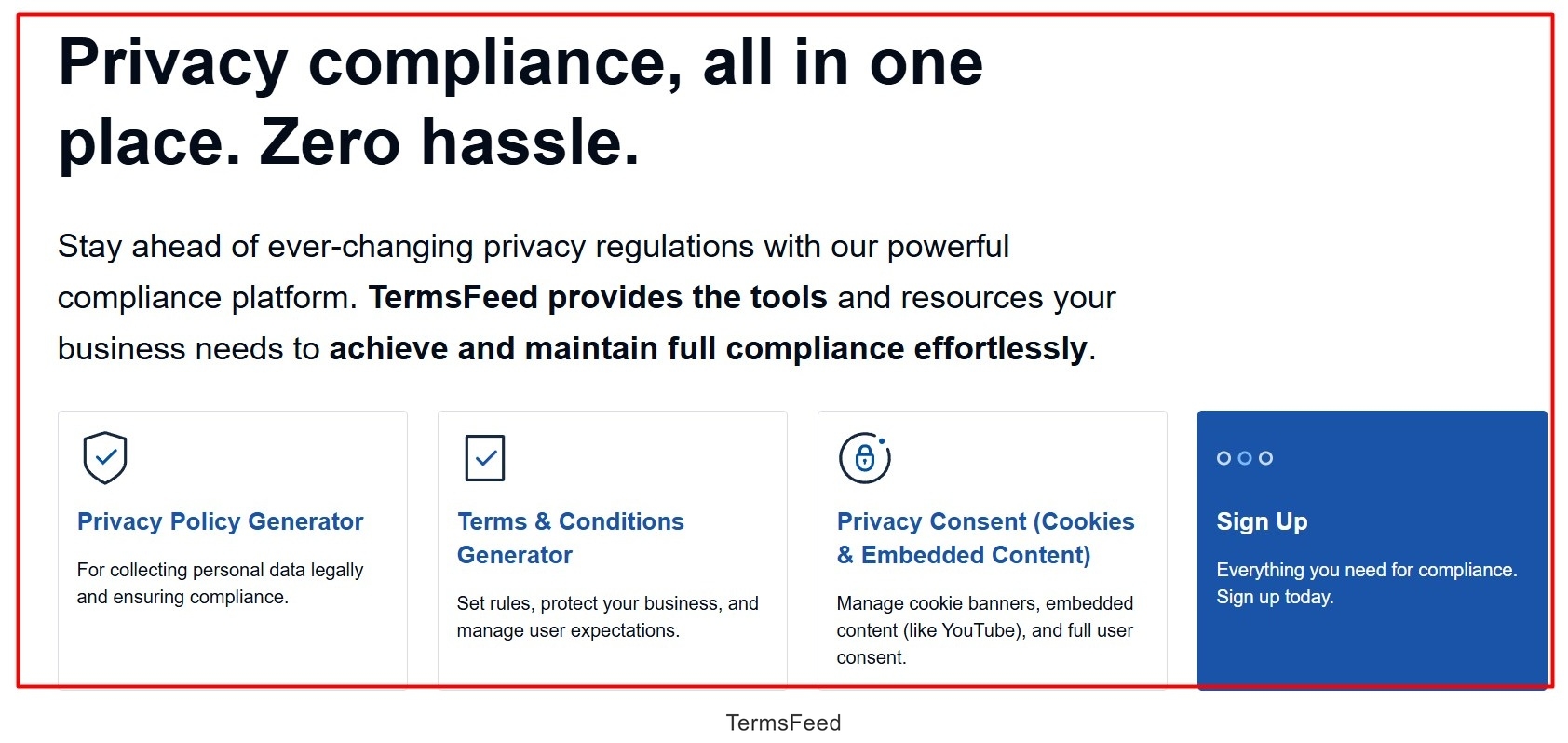
TermsFeed: The best alternative to Ketch is TermsFeed, a platform that provides tools for generating legal policies, managing consent banners, and creating legal templates. TermsFeed is a strong option for small businesses or websites that want an all-in-one privacy compliance and consent management platform.
- OneTrust: OneTrust provides scalable tools that bring together consent management, privacy automation, and data governance, making it well-suited for growing organizations managing global privacy requirements.
- TrustArc: TrustArc offers automated consent and data subject request management tools and data governance apps, supporting large organizations in building and maintaining an audit-ready privacy program.
- Osano: Osano offers consent and data privacy management and vendor risk oversight. Its $500,000 "No Fines, No Penalties" Guarantee makes it a good choice for organizations managing both compliance and vendor risk.
- Cookiebot: Cookiebot offers budget-friendly solutions for cookie scanning, consent banners, and compliance reporting, making it a strong option for businesses that need flexible pricing for privacy compliance.
- Usercentrics: Usercentrics offers plans for businesses of all sizes that include features like customizable banners, unlimited website scans, and support for multiple domains.
- BigID: BigID focuses on data and AI discovery, classification, and management, with pricing based on factors like data sources and support levels, making it a good option for businesses that need a customizable privacy solution.
- Securiti: Securiti offers data privacy, security, governance, and AI compliance, with automation across multiple regulatory frameworks, making it a good option for organizations that need unified control of data and AI across hybrid and multi-cloud environments.
- DataGrail: Offers a no-code setup for consent management, along with data mapping and a data subject request manager, making it a strong option for companies seeking an all-in-one privacy management solution that doesn't require technical expertise.
- Transcend: Transcend offers data discovery and classification, automated privacy management tools, and risk assessments. Transcend solutions are designed to help AI, consumer, fintech, media, and B2B companies comply with state and global privacy laws.
- Termly: Termly combines consent management with legal policy generation tools, making it a strong fit for small businesses that want both cookie consent and legal documents in a single platform.
- CookieYes: CookieYes offers cookie scanning, auto-blocking, and Google Consent Mode integration. CookieYes is ideal for businesses that need an affordable and user-friendly cookie compliance solution.
- Privado: Privado offers privacy risk monitoring for websites and apps, data mapping, and privacy governance. With plans starting at $250 per website per month, Privado is best for established businesses that can afford the investment.
- Didomi: Provides cross-device consent tracking and granular consent controls. Didomi is a good choice for businesses that need a customizable privacy compliance platform that supports multi-domain setups.
- Ethyca: Ethyca codifies legal requirements into machine-readable policies, enabling automated enforcement of consent, data rights, and retention rules. It is well-suited for businesses seeking flexible privacy tools.
- Iubenda: Iubenda provides legal policy generators, cookie banners, and consent management tools, with plans for small websites and high-traffic enterprises alike.
- MineOS: MineOS provides tools for privacy, risk, and AI governance management. It is a good choice for businesses that want policies documented and executed by AI agents.
- Secure Privacy: Secure Privacy unifies cookie consent management and privacy governance with a straightforward, cost-effective approach, making it a good option for small to mid-sized businesses scaling compliance globally.
- Piwik PRO: Piwik PRO combines privacy-compliant analytics with consent, tag management, and data management tools; ideal for organizations that want analytics and privacy built into a single compliance-focused platform.
- Enzuzo: Enzuzo offers consent management, DSAR automation, and legal policy generation tools; a good fit for companies that want a privacy solution that offers consent and legal policy tools in one platform.

What is the History of Ketch?
The history of Ketch is rooted in its founding in 2020 in San Francisco by Tom Chavez (CEO) and Vivek Vaidya (CTO).
Ketch rebranded from Switchbit to Ketch in 2020. In 2021, the company announced early funding rounds totaling $40M+ in Series A funding, backed by investors including CRV, Acrew Capital, Ridge Ventures, and super{set}.
Since then, Ketch has expanded its product into a broader privacy platform covering consent management and data rights automation and has been recognized by industry analysts such as Gartner and IDC.
Wondering what is Ketch and who it is for? The Ketch tool is for mid-market to enterprise businesses. It is positioned as a modern, developer-friendly alternative to legacy privacy management platforms and is used by companies of all sizes that need consent management and DSAR automation.

The first step to compliance: A Privacy Policy.
Stay compliant with our agreements, policies, and consent banners — everything you need, all in one place.


