


AI Summarize


Share


Didomi is a French enterprise consent and preference management platform designed for mid-market and enterprise organizations operating across web, mobile, and connected TV channels. This Didomi review explains key features of the Didomi software, including a multi-regulation consent management platform (CMP) with auto-geolocation, preference management for collecting zero-party data, and connected TV consent management.
Looking for Didomi reviews? This article covers the pros of the Didomi tool, including its 4.5/5 rating on G2 from 160+ reviews and its status as a Google Gold CMP Partner, and cons such as Didomi pricing only available through a sales consultation.
Use our Cookie Consent all-in-one solution (Privacy Consent) for cookies management to comply with GDPR & CCPA/CPRA and other privacy laws:
- For GDPR, CCPA/CPRA and other privacy laws
- Apply privacy requirements based on user location
- Get consent prior to third-party scripts loading
- Works for desktop, tables and mobile devices
- Customize the appearance to match your brand style
Create your Cookie Consent banner today to comply with GDPR, CCPA/CPRA and other privacy laws:
-
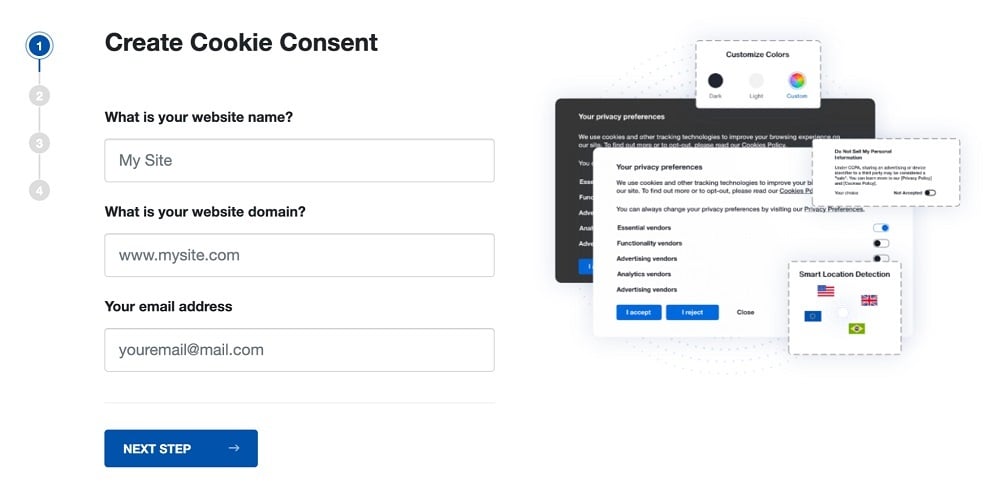
Start the Privacy Consent wizard to create the Cookie Consent code by adding your website information.
-
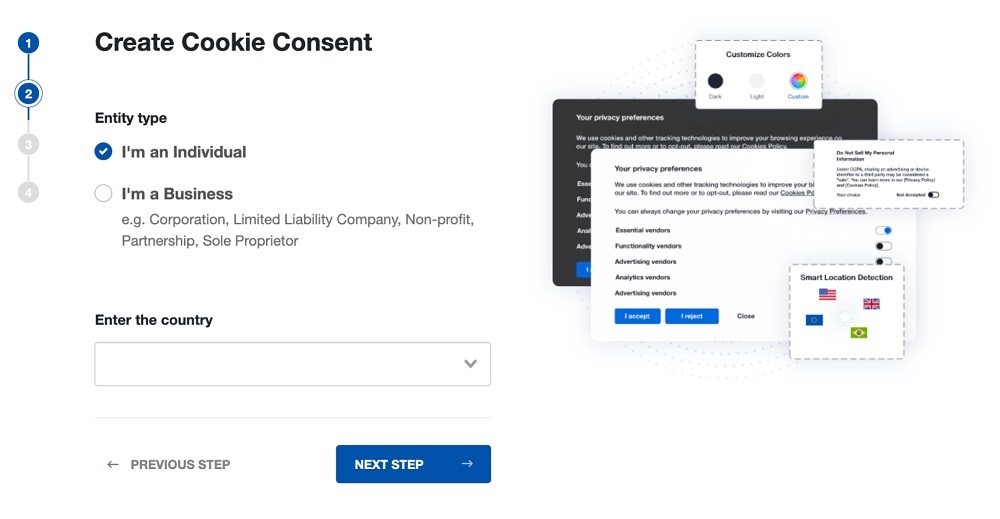
At Step 2, add in information about your business.
-
At Step 3, select a plan for the Cookie Consent.
-
You're done! Your Cookie Consent Banner is ready. Install the Cookie Consent banner on your website:
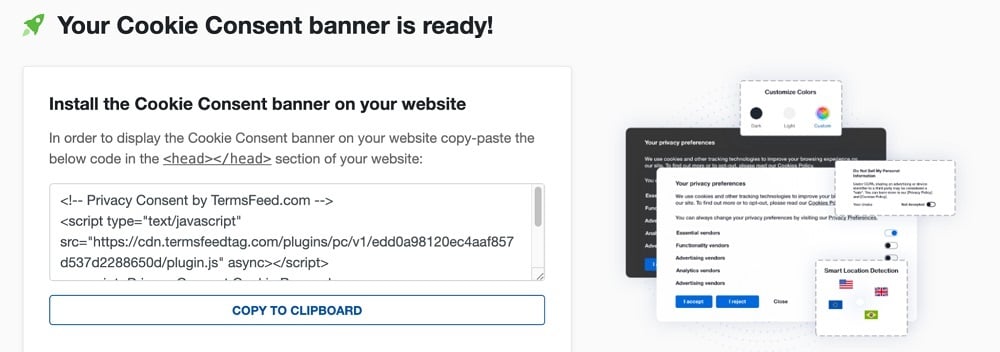
Display the Cookie Consent banner on your website by copy-paste the installation code in the
<head></head>section of your website. Instructions how to add in the code for specific platforms (WordPress, Shopify, Wix and more) are available on the Install page.


- 1. What is Didomi?
- 2. What is the Didomi Price?
- 3. What are the Best Didomi Features?
- 3.1. 1. Multi-Regulation Consent Management (CMP)
- 3.2. 2. Preference Management Platform
- 3.3. 3. Privacy Request Module (DSAR Management)
- 3.4. 4. Advanced Compliance Monitoring
- 3.5. 5. Cross-Device Consent Synchronization
- 3.6. 6. Connected TV (CTV) Consent Management
- 3.7. 7. Google Consent Mode V2 Integration
- 3.8. 8. A/B Testing for Consent Banners
- 3.9. 9. Analytics & Reporting Dashboard
- 3.10. 10. Multi-Language Support (45+ Languages)
- 3.11. 11. White-Label Customization
- 3.12. 12. Server-Side Tagging (via Addingwell)
- 3.13. 13. IAB TCF v2.2/v2.3 Compliance
- 3.14. 14. Integration Ecosystem
- 4. How does Didomi Tool Work?
- 4.1. Prerequisites & Components
- 4.2. Step-by-Step Process Flow
- 4.3. Key Mechanisms Explained
- 4.4. Edge Cases & Failure Modes
- 5. What are the Pros of Didomi?
- 6. What are the Cons of Didomi?
- 7. What are the alternatives to Didomi?
- 7.1. What is the history of Didomi?
What is Didomi?
Didomi is a CMP that enables organizations to collect, store, and manage user consent across websites, mobile apps, and connected TV devices.
Wondering what is Didomi and what does it do? Didomi is a privacy platform that helps organizations manage compliance from a centralized system, offering tools for consent banners, preference management, data subject access request (DSAR) handling, compliance monitoring, and vendor tracking.
The Didomi tool is designed for organizations managing multiple digital properties across jurisdictions, including media publishers, e-commerce retailers, ad networks, mobile/streaming companies, and digital agencies.
Didomi was founded in 2017 in Paris, France, and is a Google Gold CMP partner with International Organization of Standardization (ISO) 27001 certification. It supports global privacy standards such as the Interactive Advertising Bureau (IAB) Transparency and Consent Framework (TCF) v2.2 and 2.3, helping organizations ensure consistent consent signaling and privacy compliance across digital ecosystems.
Didomi software is backed by funding that includes 72M€ raised from Marlin Equity Partners in 2025, and has expanded through acquisitions such as Addingwell (server-side tagging) and Sourcepoint (publisher CMP technology).
What is the Didomi Price?
The Didomi price is only available through a sales consultant.
Didomi pricing is not publicly disclosed. To find out Didomi cost, you must contact sales for a custom quote.
There are three all-in-one Didomi plans:
- Essential: Includes customizable consent management, integrations, consent analytics, cross-domain consent, monthly scanning for up to 10 domains, and basic support.
- Advanced: This plan includes everything in the Essential plan and adds analytics exports for one destination, white labeling, compliance monitoring, admin Application Programming Interface (API), and Single Sign-On (SSO) for up to 10 seats.
- Premium: Includes everything in the Advanced plan and adds preference management, weekly scanning for 25 domains, analytics exports for 2 destinations, SSO for up to 100 seats, and premium support.
Pricing depends on which services businesses need and is based on factors including monthly unique visitors (MUV), scans, and database size:
- All-in-one plans, CMP, and connected TV (CTV) offers: Pricing depends on the number of MUV.
- Advanced Compliance Monitoring (ACM): Cost is based on the number of scans.
- Preference Management Platform (PMP): Pricing depends on user database size and API Calls.
- Server-Side Tagging plans: Plans depend on the number of requests per month.
Is Didomi worth it? Without transparent pricing, it's difficult to compare the affordability of Didomi features with other CMPs. However, Didomi positions itself as offering more predictable pricing compared to platforms like OneTrust, and its modular pricing approach allows businesses to purchase only the features they need.
Businesses that value transparent pricing and free trials that don't require a sales demo will likely do better with plans that offer upfront pricing and self-serve free-tier options.
What are the Best Didomi Features?
The best Didomi features are capabilities like consent, preference, and DSAR management that help businesses respect user privacy choices and comply with data protection laws.
Key Didomi capabilities include:
- Multi-Regulation Consent Management (CMP). Helps businesses comply with state and global privacy laws like the California Consumer Privacy Act (CCPA) and the General Data Protection Regulation (GDPR) by presenting region-specific consent banners.
- Preference Management Platform. Lets users control communication and privacy preferences, helping businesses collect zero-party data and improve trust.
- Privacy Request Module (DSAR Management). Automates data access, deletion, and correction requests, reducing manual workload and improving compliance speed.
- Advanced Compliance Monitoring. Scans sites for tracking technology and unauthorized behavior, helping proactively identify issues.
- Cross-Device Consent Synchronization. Syncs consent across devices like mobile, desktop, and CTV.
- Connected TV (CTV) Consent Management. Handles consent on smart TVs and streaming apps.
- Google Consent Mode V2 Integration. Sends consent signals to Google tools, supporting compliance with Google requirements and privacy regulations while honoring user consent choices.
- A/B Testing for Consent Banners. Tests different banner designs and messaging, helping improve opt-in rates.
- Analytics & Reporting Dashboard. Shows consent rates and compliance performance, helping teams optimize privacy strategy.
- Multi-Language Support (45+ Languages). Displays consent experiences in multiple languages, supporting global audiences.
- White-Label Customization. Allows organizations to fully brand consent experiences, helping maintain a consistent look and feel across digital properties.
- Server-Side Tagging (via Addingwell). Enables server-side tracking for better performance and privacy control, reducing reliance on browser tracking.
- IAB TCF v2.2/v2.3 Compliance. Supports standardized consent signals for digital advertising ecosystems, helping maintain compatibility with ad tech partners and industry consent frameworks.
- Integration Ecosystem. Connects with analytics, customer relationship management (CRM), and marketing tools, enabling seamless consent data flow across systems.
Let's take a deeper look at some of the top Didomi features.
1. Multi-Regulation Consent Management (CMP)
Multi-regulation consent management (CMP) is a feature that collects and manages user consent through customizable banners and pop-ups across websites, mobile apps, and connected TV environments.
It supports multiple privacy regulations from a single consent configuration that automatically adapts based on a visitor's geolocation.
Didomi consent management helps businesses comply with privacy laws from around the world, including:
- European Union (EU): GDPR
- United States (US): US state privacy laws, including the CCPA and the Virginia Consumer Data Protection Act (VCDPA)
- Brazil: Lei Geral de Proteção de Dados Pessoais (LGPD)
- Canada: Personal Information Protection and Electronic Documents Act (PIPEDA)
- South Africa: Protection of Personal Information Act (POPIA)
The Didomi consent management platform centralizes global privacy compliance by automatically detecting visitor location and serving the appropriate consent experience. This allows legal, compliance, and marketing teams to manage consent requirements across jurisdictions from a single platform, while maintaining a consistent user experience worldwide.
For example, a multinational e-commerce brand serves GDPR-compliant consent banners to users in the EU, displays a CCPA notice to California visitors, and presents LGPD consent options to users in Brazil from a single Didomi configuration.

2. Preference Management Platform
Preference management platform is a feature that allows organizations to deploy customer preference widgets to collect zero-party data such as marketing preferences, communication frequency, and topics of interest. It reduces reliance on traditional cookie-based tracking and enables businesses to maintain user choices across devices and sessions.
Didomi preference management is valuable because it strengthens first-party data strategies by capturing explicit user preferences directly from customers, enabling businesses to build more accurate customer profiles based on stated preferences rather than inferred behavior.
Businesses use Didomi to create customized preference centers to collect and manage customer consent choices.

Since this information is stored centrally rather than being tied to browser cookies, it improves the reliability of preference data.
For example, a media publisher stores reader content preferences centrally so they remain consistent across devices and are used to personalize newsletter topics based on explicit user choices rather than assumptions.
Note that preference management is only available on the Premium plan.
3. Privacy Request Module (DSAR Management)
Privacy request module is a feature that helps organizations handle data subject access requests (DSARs) from start to finish using customizable forms, centralized storage, and built-in deadline tracking with countdown timers to help ensure regulatory timelines are met.
Didomi privacy request module is valuable because it replaces manual, email-based DSAR management with a centralized system that standardizes how privacy requests are received, processed, and resolved. Instead of tracking requests across inboxes and spreadsheets, organizations manage everything in one organized workflow.
Businesses benefit from DSAR workflow automation as it helps teams track progress against required response timelines and manage requests more consistently.
Didomi enables businesses to collect customer preferences via widgets, forms, or separate domains.

Privacy request management is only available on the Premium plan.
4. Advanced Compliance Monitoring
Advanced compliance monitoring is a feature that automatically scans websites on a weekly or monthly basis to detect unauthorized cookies, trackers, and third-party code.
This helps identify issues and misconfigurations, such as SDK or Google Consent Mode errors, and supports more consistent consent operations. Ongoing scans flag unauthorized behavior and implementation issues, making it easier to fix errors quickly and reduce compliance risks across your websites.
Didomi compliance monitoring is valuable because it helps businesses take a proactive approach. Rather than relying on manual or reactive audits after issues are found, it continuously monitors for potential problems such as unauthorized behavior and implementation issues as they emerge.
Businesses benefit from faster and more consistent assessments of compliance status across all domains, enabling teams to quickly identify and prioritize areas that need remediation.
Didomi helps organizations stay compliant by discovering hidden trackers and incorrect implementations.

Monthly scans are available on the Essential and Advanced plans; Premium plan users have access to weekly scans.
5. Cross-Device Consent Synchronization
Cross-device consent synchronization is a feature that uses consent synchronization to share a user's privacy choices across desktop, mobile, and CTV environments, so users only need to provide consent once.
Didomi cross-device consent is valuable because it improves the user experience by preventing known users from being repeatedly prompted for the same privacy choices across devices and platforms.
Users benefit from a more consistent privacy experience, with consent preferences automatically respected across all supported devices, reducing consent fatigue and helping businesses lower bounce rates.
Cross-device consent is only available upon request.
6. Connected TV (CTV) Consent Management
Connected TV (CTV) consent management is a feature that helps streaming and media companies collect and manage user consent across CTV apps on platforms such as Apple TV, Android TV, and Amazon Fire TV.
Didomi connected TV is one of only 9 CMPs globally with Google CTV certification, and it was the first European CMP to offer a TCF-compliant CTV consent solution.
A single platform for CTV, web, and mobile consent keeps privacy settings consistent and makes it easier to manage consent across devices, helping businesses meet privacy requirements.
CTV consent management is available upon request.
7. Google Consent Mode V2 Integration
Google Consent Mode V2 integration is a feature that adjusts Google tag behavior based on user consent status without requiring additional code.
Didomi is a Google Gold Partner, which means that it meets Google standards for consent management. Didomi Google Consent Mode helps organizations comply with Google consent requirements by transmitting consent signals to tools such as Google Analytics, Google Ads, and Google Tag Manager.
Businesses benefit from faster implementation and more compliant data handling across marketing and analytics tools. With Google Consent Mode enabled by default in Didomi, consent signals are automatically shared with Google services once banners are configured.
8. A/B Testing for Consent Banners
A/B Testing for consent banners is a feature that allows organizations to test different banner designs, copy, and configurations to optimize consent rates across websites and apps.
Didomi A/B testing enables structured consent banner testing so organizations are able to compare variations and identify what drives higher user engagement and acceptance.
Consent banner testing is valuable because it provides data-driven optimization, helping organizations make decisions based on real user behavior rather than assumptions. By continuously testing and refining banner experiences, businesses improve performance opt-in rates over time.
9. Analytics & Reporting Dashboard
Analytics & reporting dashboard is a feature that helps businesses track consent performance, including consent rates, opt-in and opt-out trends, and traffic metrics across websites and apps.
Didomi analytics and reporting dashboard tools give organizations visibility into how users interact with consent banners across websites and apps by consolidating consent data into a single view, making it easier to understand performance and compliance status across all properties and identify patterns and areas for improvement.
By monitoring consent trends over time, organizations are able to make informed decisions to optimize consent rates while keeping up with privacy requirements.
Organizations are able to organize Didomi CMP metrics by notice scope, which provides insights about opt-ins, consent rates, and no-choice rates, or traffic scope, which shows opt-in and opt-out rates across website traffic and app sessions.

10. Multi-Language Support (45+ Languages)
Multi-language support is a feature that uses browser-based language detection to display localized consent notices to users around the world.
Didomi multi-language support helps organizations deliver consent experiences that automatically adapt to a visitor's language and location across websites and apps. With support for more than 45 languages, Didomi helps companies deliver consistent privacy experiences globally.
Businesses provide a more accessible and user-friendly privacy experience by automatically showing consent notices in each visitor's native language.
11. White-Label Customization
White-label customization is the ability to remove the Didomi logo, giving businesses greater control over branding.
Didomi white-label customization allows organizations to align the appearance of consent banners with their brand across websites and apps.
This is valuable because it helps businesses maintain a consistent user experience and ensures consent banners are displayed without visible third-party branding.
12. Server-Side Tagging (via Addingwell)
Server-side tagging is a feature that helps organizations process tracking data on a server rather than in a browser, reducing reliance on third-party scripts loaded on user devices and improving site performance and data reliability.
Didomi server-side tagging became available following the acquisition of Addingwell in April 2025 and provides infrastructure that reduces dependence on third-party JavaScript and gives organizations greater control over how data is collected and processed.
This feature is valuable because it helps reduce the impact of ad blockers and browser-based tracking restrictions while improving performance metrics such as Core Web Vitals.
By handling tracking on the server side, businesses improve website speed, user experience, and overall data management.
13. IAB TCF v2.2/v2.3 Compliance
IAB TCF v2.2/v2.3 compliance is a feature that helps publishers and advertisers manage user consent in a standardized way across the programmatic advertising ecosystem, enabling consistent communication of consent signals to advertising partners.
Didomi IAB TCF compliance is built into its CMP and supports consent signal transmission across the advertising supply chain. Didomi is an IAB Europe-approved CMP that helps organizations maintain accurate vendor lists by synchronizing only detected vendors in consent notices, reducing the risk of transparency issues and privacy compliance risks.
It provides a pre-configured TCF v2.3 template in its Console, which includes the latest IAB updates, such as the Disclosed Vendors requirement.
This is valuable because it supports standardized consent signaling across ad tech partners while helping organizations stay aligned with evolving IAB TCF requirements.
For publishers, this means they are able to monetize their digital content through programmatic advertising while remaining compliant with TCF requirements and user privacy regulations.
14. Integration Ecosystem
Integration ecosystem is a feature that connects Didomi with a wide range of marketing, analytics, and content platforms, supporting consent management across existing digital tools.
Didomi integrations include connections with platforms such as Google Tag Manager, Adobe Experience Cloud, Salesforce, HubSpot, Marketo, Tealium, Piano, WordPress, and Drupal. This integration ecosystem enables consent signals to be transmitted across key systems used for analytics, marketing automation, advertising, and content management.
This is valuable because it helps ensure consent decisions are consistently applied across major marketing and analytics platforms. Many integrations are available as pre-built connectors, reducing the need for custom development when connecting Didomi to existing tools and workflows.
How does Didomi Tool Work?
Didomi works by integrating a consent management layer into websites and apps through a JavaScript tag, mobile SDK, or CMS plugin. After setup, it automatically detects user location and delivers the correct consent experience based on regional privacy requirements.
Wondering how to use Didomi? Here's how Didomi works:
- The Didomi tag or SDK is deployed on a website or app.
- The system automatically detects user location.
- A region-specific consent banner is displayed.
- User consent preferences are collected.
- Consent signals are passed to connected marketing, analytics, and advertising tools so those systems respect user choices.
- Consent records are logged for audit purposes.
- Ongoing compliance is monitored through reporting and dashboard tools.
Key mechanisms within Didomi include:
- Geolocation-based consent routing
- Cross-device consent synchronization
- Compliance monitoring features
- Vendor monitoring to track third-party script activity
These components work together to ensure consent is properly captured, applied, and maintained across digital environments.
To use Didomi, organizations need a Didomi account and access to their website or app to install the tag, SDK, or plugin. A demo is available upon request, but there is no self-serve free plan.
Prerequisites & Components
Prerequisites & components include access to a website or app and a way to integrate the Didomi platform, such as a JavaScript tag, SDK, or CMS plugin. These elements enable the system to function properly and display consent choices to users.
Setup happens in a central admin console, where organizations define consent categories (such as analytics or marketing cookies), customize consent banners, and align settings with regional privacy requirements.
Implementation involves connecting digital properties to the platform and configuring these settings to ensure the appropriate consent experience is delivered to visitors based on their location and applicable regulations.
Step-by-Step Process Flow
Step-by-step process flow begins with a sales consultation to help select the appropriate plan and features based on compliance needs and requires a Didomi account and access to the website or app where the consent solution will be deployed.
Once the account is set up, the installation process typically involves the following steps:
- Deploy the JavaScript tag or SDK.
- Configure the consent experience.
- Set up geolocation rules to ensure the correct consent experience is shown by region.
- Connect relevant integrations (such as analytics or marketing tools).
- Configure a preference center where users manage consent choices.
- Test the setup across different regions to confirm correct behavior.
- Go live once configuration and testing are complete.
Within the platform console, organizations typically:
- Design and customize the consent banner (layout, text, and behavior)
- Define consent categories (such as analytics, marketing, or functional cookies)
- Manage vendor lists
- Set up compliance monitoring to track consent activity and configuration status
Before full deployment, businesses usually:
- Test the consent flow across regions to ensure correct banner behavior
- Verify that consent choices are properly enforced across downstream tools and integrations
- Review compliance reports to make sure everything is set up correctly and ready to go live
Key Mechanisms Explained
Didomi works by collecting, storing, and enforcing user privacy choices across websites and apps.
Organizations define consent categories, set regional rules based on privacy requirements, and manage activation of third-party vendors depending on user consent.
It uses a script or SDK embedded in a site or app to display a consent banner where users accept, reject, or customize their preferences. These choices are then stored and enforced across sessions and devices (depending on setup).
Once consent is collected, the platform enforces those decisions by controlling which tags and tools are allowed to run, helping ensure data collection matches user preferences.
Reporting tools provide visibility into consent activity and configuration status, supporting compliance with applicable privacy laws.
Edge Cases & Failure Modes
Edge cases & failure modes include technical issues such as script loading errors or tag misconfiguration, as well as integration issues involving IAB frameworks.
Issues involving third party-integrations, such as IAB frameworks, disrupt ad measurement or targeting and lead to potential revenue impact. These issues are time-sensitive, but support is not always readily available, delaying resolution.
Some users report that while documentation is extensive, resolving more technical tasks (like configuring tags for non-IAB vendors in tools such as Google Tag Manager) requires additional support.
Finally, certain tools require custom integration rather than plug-and-play support.
What are the Pros of Didomi?
The pros of Didomi are benefits like strong user reviews, Google Gold CMP and ISO 27001 certification, and CTV support.
Didomi advantages include:
- Strong G2 ratings (4.5/5, 160+ reviews, G2 leader for 12 consecutive seasons): This reflects high user satisfaction and consistent market recognition over time. It suggests the platform is reliable in real-world enterprise use and meets customer expectations across implementation and support.
- Google Gold CMP Partner (web, mobile, and CTV certified): This certification confirms compatibility with Google tools, helping reduce integration issues and ensuring compliance with Google advertising requirements.
- ISO 27001 certified: This certification reflects strong information security practices, helping ensure user data is handled securely.
- IAB TCF v2.2/v2.3 compliant and active standards contributor: Compliance with IAB TCF helps ensure consistent consent handling across advertising systems and improves compatibility with ad tech partners.
- Connected TV support (one of only 9 Google CTV-certified CMPs globally): CTV support enables advertisers and publishers to manage consent in connected TV environments.
- Praised customer support and onboarding: Users frequently highlight onboarding and support as helpful during implementation. This reduces setup time and helps businesses resolve configuration issues more efficiently.
- Broad regulation coverage (GDPR, CCPA/CPRA, LGPD, PIPEDA, POPIA, 15+ US state laws): Didomi supports compliance with multiple state and global privacy laws in a single system, eliminating the need for separate consent tools for each region.
- Cross-device consent sync reduces consent fatigue: This feature carries consent preferences across devices and sessions, reducing repeated prompts and improving user experience consistency.
- 45+ Languages with auto-detection: The platform detects user language automatically, and displays consent banners in the appropriate language, improving usability and supporting compliance across regions.
- Compliance Health Score: Didomi's proprietary 15-dimensional score grades how well a site meets consent, vendor, and tracker compliance requirements, making gaps fast to spot across properties..
- Modular platform (buy only what you need): Didomi offers different modules for consent, advanced compliance, and preference management, allowing organizations to choose the features they need.
- Server-side tagging capability (post-Addingwell acquisition): This enables data to be processed on servers instead of relying only on browser-based scripts, giving businesses more control over data collection and helping improve reliability and performance in some setups.
- Active acquisition strategy (Addingwell April 2025, Sourcepoint July 2025): These acquisitions expand the consent management and data infrastructure of Didomi, strengthening its ability to support privacy and consent-related processes.
- Strong enterprise track record (Rakuten, Hachette Livre, Pierre & Vacances): Adoption by large global organizations suggests scalability and enterprise readiness, indicating that the platform is suitable for use in high-traffic and regulated environments.
What are the Cons of Didomi?
The cons of Didomi are issues that include a lack of pricing transparency, customer support delays, and advanced features restricted to higher-tier plans.
Didomi limitations include:
- No public pricing (requires sales consultation): One of the main Didomi disadvantages is that pricing is not publicly listed and requires contacting sales for a quote, making it harder for organizations to compare options or find quick, self-serve CMP solutions.
- Premium/expensive positioning (higher end of CMP market): The platform is positioned as an enterprise-grade solution, making it potentially more expensive compared to simpler CMP tools. This creates budget challenges for smaller organizations or organizations with limited resources.
- No free plan or free trial: Didomi typically requires a sales consultation rather than offering a self-serve free plan or trial, making independent testing and comparison more difficult for companies that prefer evaluating CMPs before speaking with sales.
- Page load performance impact (reported by multiple reviewers): Some users report that implementation and configuration choices affect website performance, with feedback mentioning the need for careful technical setup.
- Limited banner design customization without custom Cascading Style Sheets (CSS): More advanced design customization requires CSS or developer support, limiting flexibility for non-technical users.
- Email-based support can be slow for urgent issues: Some support interactions rely on email, delaying resolution of time-sensitive issues.
- Mobile app consent banner limitations (no mobile preview): Consent notice previews are not yet available for mobile app environments, requiring in-app testing.
- Learning curve for advanced multi-vendor configurations: Advanced setups involving multiple vendors and complex rules often require technical expertise to configure and manage effectively.
- Cookie control by vendor, not by cookie type/purpose: Some configurations focus on vendor-level control rather than granular cookie-level categorization, which limits fine-tuned control.
- No automatic sensitive data detection or categorization: Didomi does not document automatic sensitive data classification for cookies. It relies on purpose- and vendor-based categorization frameworks, potentially requiring manual configuration for organizations with strict data classification needs.
- Some features gated to highest tier: Some features are included in higher-tier plans, resulting in limited access for lower-tier customers.
- Platform glitches reported by users: Some users report occasional bugs or configuration issues that potentially require support intervention.
What are the alternatives to Didomi?
The alternatives to Didomi are competitors like TermsFeed that provide Privacy Policy generation, cookie consent banners, and legal compliance tools for small to mid-sized websites seeking simpler, self-serve alternatives to enterprise consent management platforms.
Didomi alternatives include:
- TermsFeed is the best alternative to Didomi as it provides Privacy and Cookie Policy generators, consent banners, and legal policy templates, making it ideal for small businesses and websites seeking both legal documentation and consent management in a single platform.
- OneTrust: Provides scalable tools that combine consent management, privacy automation, and data governance, making it suitable for growing organizations handling global privacy requirements.
- Usercentrics: Provides solutions for businesses of all sizes, offering features such as customizable consent banners, unlimited website scans, and multi-domain support.
- Cookiebot (by Usercentrics): Provides cost-effective tools for cookie scanning, consent banners, and compliance reporting, making it a suitable option for businesses seeking flexible pricing for privacy compliance solutions.
- TrustArc: Offers automated consent management, data subject request handling, and data governance tools, supporting large organizations in maintaining audit readiness.
- CookieYes: Offers cookie scanning, auto-blocking, and Google Consent Mode integration, making it a practical option for businesses looking for a cost-effective and user-friendly cookie compliance tool.
- Osano: Provides consent and data privacy management along with vendor risk oversight, and its "No Fines, No Penalties" guarantee positions it as a strong option for organizations focused on both compliance management and vendor risk control.
- Ketch: Includes website tracker scanning, legal templates, and consent record management. Its pricing is based on monthly visitor volume, making it suitable for websites seeking predictable, traffic-based pricing.
- Quantcast Choice: Offers cookieless advertising support and AI-driven insights to help websites optimize ad performance and audience targeting.
- iubenda:Offers tools for generating legal policies, managing cookie banners, and handling consent, with pricing plans suited for both small websites and high-traffic enterprise use cases.
- consentmanager: Focused on GDPR, TCF compliance, and cookie consent with strong reporting and customization features, and is designed to support publishers, online shops, agencies, Data Protection Officers (DPOs), and international organizations.
- Sourcepoint (now acquired by Didomi): Provides enterprise-grade compliance monitoring, universal consent and preference management, and DSAR handling; best for larger organizations that need to manage privacy at scale.
- Enzuzo: Offers consent management, DSAR automation, and legal policy generation tools, making it suitable for companies seeking a solution for privacy compliance and legal documentation within a single platform.
- Securiti: Delivers capabilities for data privacy, security, governance, and artificial intelligence (AI) compliance, with automation across multiple regulatory frameworks, making it well-suited for organizations seeking centralized control of data and AI in hybrid and multi-cloud environments.
- BigID: Focuses on data and AI-driven discovery, classification, and management, with pricing structured around factors such as data sources and support levels, making it suitable for businesses seeking a highly customizable privacy solution.
- Termly: Combines consent management with legal policy generation tools, making it a good fit for small businesses looking to manage cookie consent and generate legal documents in one platform.
- Complianz: Provides automated cookie banners, consent management, and legal document generation within WordPress, making it well-suited for WordPress sites that need customizable compliance tools.
- Axeptio: Provides customizable consent banners and IAB TCF compliance, making it good for publishers and agencies that prioritize user experience and aim to improve consent rates through enhanced banner design.
- Piwik PRO: Best for organizations that want privacy law-compliant analytics, Piwik PRO provides analytics, consent, tag management, and data management tools.
- Tealium: Offers built-in consent, identity, and AI governance. The platform is designed to help marketing, data and analytics, and AI teams connect customer data, improve decision-making, and manage privacy across websites, apps, and cloud systems.
What is the history of Didomi?
The history of Didomi is the story of a Paris-based privacy software company that grew from a GDPR-era startup into a global consent and privacy platform through venture funding, international expansion, and strategic acquisitions.
Didomi was founded in 2017 in Paris, France, by Chief Executive Officer (CEO) Romain Gauthier, Chief Technology Officer (CTO) Jawad Stouli, and Chief Revenue Officer (CRO) Raphaël Boukris.
The timeline of the Didomi tool is as follows:
- 2017–2020: Didomi operated as a bootstrapped company while expanding during the early enforcement years of GDPR.
- June 2020: Didomi raised €5 million (~$5.7 million USD) in Series A funding from Breega and Bpifrance.
- July 2021: In July 2021, Didomi raised $40 million (€33.8 million) in Series B funding from Elephant and Breega, supporting expansion into the US market.
- September 2024: Didomi achieved Google Gold CMP Partner status.
- April 2025: In April 2025, Marlin Equity Partners made an $83 million (€72 million) majority investment in Didomi, and Didomi acquired Addingwell to add server-side tagging capabilities to its privacy platform.
- July 2025: Didomi acquired Sourcepoint, significantly expanding Didomi's presence in publishing and media privacy infrastructure.
- Winter 2026: Didomi reported being recognized as a G2 Leader in consent management for 12 consecutive seasons.
From 2020 to 2025, Didomi software raised approximately $129 million in disclosed funding across a €5 million Series A, a $40 million Series B, and a €72 million growth investment led by Marlin Equity Partners.
Didomi operates in more than 35 countries, serves over 1,500 customers, and is majority-owned by Marlin Equity Partners. The company is estimated to have between 51 to 200 employees and lists organizations such as Rakuten, Hachette Livre, and Pierre & Vacances among its named customers.
In summary, to answer the question, what is Didomi? Didomi is a privacy software platform that helps organizations collect consent, manage user preferences, monitor vendors and trackers, and comply with privacy regulations across websites, mobile apps, connected TV, and other digital channels.

The first step to compliance: A Privacy Policy.
Stay compliant with our agreements, policies, and consent banners — everything you need, all in one place.


