


AI Summarize


Share


Axeptio is a French consent management platform (CMP) that turns cookie banners into branded, visually engaging experiences for website visitors.
This Axeptio review covers what the Axeptio tool does, how it is priced, and how the Axeptio software compares to other tools.
The Axeptio software has 3 particularly useful features:
- A branded Consent Experience Builder that uses video, motion design, and custom brand assets.
- Native A/B Testing for consent banner optimization.
- The Taste browser extension. This is a free tool that manages cookie preferences.
Paid plans cost from €29 to €129 per month. A free tier is available for sites with fewer than 200 visitors per month.
The main advantage of Axeptio is its design, which case studies show achieves cookie consent rates up to 84%. The main drawback is that the Axeptio logo appears on banners for lower-tier subscribers.
TermsFeed is a good alternative to Axeptio for businesses who are looking for legal document generation rather than consent management. TermsFeed is good for businesses who are focused on content rather than user experience (UX) design.
- 1. What is Axeptio?
- 2. What is the Axeptio Price?
- 2.1. Is Axeptio worth it?
- 3. What are the Best Axeptio Features?
- 3.1. 1. Branded Consent Experience Builder
- 3.2. 2. Consent Wall
- 3.3. 3. A/B Testing for Consent Banners
- 3.4. 4. Shake (Cookie Scanner)
- 3.5. 5. Terms Widget
- 3.6. 6. Marketing Consent Module
- 3.7. 7. Taste Browser Extension
- 3.8. 8. Mobile App SDKs
- 3.9. 9. Google Consent Mode v2 (Gold Partner)
- 3.10. 10. IAB TCF v2.3 Certification
- 3.11. 11. Consent Analytics Dashboard (Stat V2)
- 3.12. 12. Multi-Regulation Compliance
- 3.13. 13. Analytics Platform Connectors
- 3.14. 14. E-commerce & CMS Integrations
- 3.15. 15. Server-Side Tracking Support
- 4. How does Axeptio Tool Work?
- 4.1. Prerequisites and Components
- 4.2. Step-by-Step Process Flow
- 4.3. Key Mechanisms Explained
- 4.4. Edge Cases and Failure Modes
- 5. What are the Pros and Cons of Axeptio?
- 5.1. What are the Pros of Axeptio?
- 5.2. What are the Cons of Axeptio?
- 6. What are the alternatives to Axeptio?
- 6.1. What is the history of Axeptio?
What is Axeptio?
Axeptio is a consent management platform (CMP) that takes a UX-focused approach to cookie compliance. Axeptio turns consent banners into visually engaging, branded experiences.
The image below shows this.

The Axeptio tool uses video, motion design, images, and a customizable tone of voice.
The main purpose of Axeptio is to help websites and mobile apps to collect, manage, and store user consent in compliance with:
- The General Data Protection Regulation (GDPR) and ePrivacy Directive
- California Consumer Privacy Act (CCPA)
- Personal Information Protection and Electronic Documents Act (PIPEDA)
- Quebec Law 25
- Swiss New Federal Act on Data Protection (nFADP)
- Brazilian Lei Geral de Proteção de Dados (LGPD)
Axeptio has Google CMP Partner Gold status. Axeptio is Interactive Advertising Bureau (IAB) TCF v2.3 certified and ISO/IEC 27001 certified. Axeptio is in use on 80,000+ websites and has 10+ billion consent records stored.
The image below shows this.

Axeptio is a no-code platform. Axeptio is designed for brands that want consent to feel like a positive brand interaction. Axeptio has a strong adoption in e-commerce, particularly on Shopify.
Axeptio is not a legal document generator. It manages the consent interaction, including the banner, the user choice, and the signals to analytics tools.
Axeptio does not generate Privacy Policies, Terms and Conditions, or other legal agreements. Businesses produce those documents separately. TermsFeed is a good alternative for businesses looking for a legal document generator.
What is the Axeptio Price?
The Axeptio price is €0 for a limited free tier and costs €129 (112GBP or 151USD) per month for the Large plan. Enterprise and Agency plans are available at custom pricing.
The image below shows the prices for Axeptio per month.

Axeptio uses a pageview-based billing model. The plan a business needs depends on the monthly traffic volume the business has.
| Plan | Monthly price | Annual price | Pageviews/month | Includes |
| Free | €0 | €0 | 200 visitors | Basic consent storage, graphic customization, Google Consent Mode v2 |
| Small | €29 (34USD) | €313 (366USD) | 5,000 | Adds IAB TCF support, basic statistics |
| Medium | €69 (80USD) | €745 (871USD) | 100,000 | Adds analytics connectors, Consent Wall |
| Large | €129 (151USD) | €1,393 (1628USD) | 500,000 | Adds standard statistics, cookie list, subdomains |
| Enterprise | Custom | Custom | Unlimited | Advanced analytics, dedicated account manager, API access |
| Agency | Custom | Custom | Unlimited | White-label, unlimited domains |
Annual billing saves approximately 10% compared to monthly billing. Mobile software development kits (SDK) pricing is separate, based on Monthly Active Users (MAU), and is not publicly listed.
Businesses that outgrow the 200-visitor free limit purchase a paid plan. The Axeptio platform does not offer seasonal or traffic-based billing, which is a limitation for sites with fluctuating monthly traffic.
Is Axeptio worth it?
Yes, Axeptio is worth the cost for brands that rely on consent rates to protect analytics and advertising revenue.
For smaller websites that only need basic cookie compliance without a branded experience, simpler options exist.
TermsFeed provides a one-time-purchase model with legal document generation that Axeptio does not offer. TermsFeed is the better choice for businesses that want a Privacy Policy, Terms and Conditions, and a cookie banner without a monthly subscription.
What are the Best Axeptio Features?
The best Axeptio features are Branded Consent Experience Builder, Consent Wall, A/B Testing for Consent Banners, Shake (Cookie Scanner), and a number of certifications and integrations.
The best Axeptio features are explained in detail below.
1. Branded Consent Experience Builder
Branded Consent Experience Builder is a no-code visual editor that lets brands create consent banners.
Brands create banners with video, motion design, images, custom colors, typography, and a personalized tone of voice. An example of this personalization is in the image below.

The Branded Consent Experience Builder is the core differentiator of Axeptio. Case studies show that Axeptio achieves high consent rates.
The Axeptio logo appears on banners for lower-tier subscribers. Removing the Axeptio branding requires upgrading to a higher plan.
2. Consent Wall
Consent Wall is a full-screen consent overlay that places the consent widget at the center of the screen. The Consent Wall requires visitors to make an active choice before continuing. Visitors still have the option to reject all cookies.
An example of the Consent Wall is in the image below.

Axeptio includes the Consent Wall from the Medium plan (€69/month, 80USD) and above.
The Consent Wall increases interaction rates. Media publishers who rely on consent rates for ad monetization use it to make sure visitors make a deliberate choice before browsing.
The Consent Wall helps businesses to comply with the GDPR. Visitors who reject all cookies still have access to the site. The Consent Wall is available for the Medium plan and above.
3. A/B Testing for Consent Banners
A/B Testing for Consent Banners is a native feature that lets businesses test different banner visuals, copy, calls to action, and widget positions.
More information about this feature is in the image below.

Examples of tests include a playful tone ("Yep, sounds good!") versus a formal one ("Accept all cookies", or a top-bar placement versus a center placement.
Data from tests feeds directly into the Consent Analytics Dashboard. The Consent Analytics Dashboard allows improvements based on evidence.
Axeptio offers A/B testing for Enterprise and Agency plans only.
4. Shake (Cookie Scanner)
Shake (Cookie Scanner) is the Axeptio automated cookie and tracker scanning tool that generates compliance reports based on cookies detected on a website.
The Shake cookie scanner process is in the image below.

Shake feeds scan results directly into the banner configuration. Shake generates compliance reports suitable for internal audits.
Shake is available before subscribing to a paid plan.
Shake is a useful free compliance audit tool. Sites re-scan after adding new third-party scripts to keep cookie disclosures accurate.
5. Terms Widget
Terms Widget is a consent module that collects and stores user consent for Terms and Conditions, Privacy Policies, and Data Processing Agreements (DPAs).
The Terms Widget has version history and automatic change highlighting.
More information about the Terms widget is in the image below.

The Axeptio Terms Widget tracks which version of a legal document each user agreed to. The widget detects changes between policy versions automatically and prompts returning users to accept the updated terms.
An e-commerce site that updates its return policy uses the Terms Widget to collect fresh consent from returning customers and maintain a complete legal audit trail.
6. Marketing Consent Module
Marketing Consent Module is a feature that collects consent and integrates marketing opt-ins into the same consent register as cookie consent.
A newsletter signup form embeds an Axeptio consent checkbox with proper legal text. That consent is then logged alongside cookie preferences in a single register.
This gives businesses one source for both cookie and marketing consent. This simplifies GDPR compliance audits.
The Axeptio Marketing Consent Module ensures marketing opt-ins meet the GDPR requirement for explicit, freely given consent.
7. Taste Browser Extension
Taste Browser Extension is a free browser extension that manages cookie preferences automatically.
Taste rates each website on its transparency and consent practices, and applies user choices without showing repeated consent banners.
Taste means end users do not see repeated consent banners on sites Taste recognizes. End users view a transparency rating (out of 100) for each site they visit. Site operators benefit from users who arrive with consent already configured.
Information about the Taste Browser Extension is in the image below.

Taste works across multiple CMPs. It recognizes banners from Usercentrics, Cookiebot, iubenda, Didomi, OneTrust, and others.
Taste is a free consumer-facing tool, not a paid feature. It is available for Chrome, Firefox, Safari, and Edge.
8. Mobile App SDKs
Mobile App SDKs is the set of native software development kits for iOS (Swift), Android (Kotlin), Flutter, and React Native. Mobile App SDKs bring Axeptio consent management to mobile applications.
The SDK stores consent locally and syncs it automatically once the device reconnects. WebView consent continuity means consent is collected in a native app and carries across embedded web views without prompting the user again.
Axeptio rolls out updates without requiring app resubmission to the App Store or Play Store.
Mobile SDK pricing is separate, based on Monthly Active Users (MAU), and is not publicly listed.
9. Google Consent Mode v2 (Gold Partner)
Google Consent Mode v2 Gold Partner status is the highest-available certification for CMPs from Google. Google Consent Mode v2 means full compatibility with Google Analytics 4 and Google Ads.
The image below shows this.

Axeptio sends consent signals directly from the banner to Google services without additional configuration.
A visitor who rejects analytics cookies triggers Axeptio to signal Google to use modeled conversions instead of direct tracking. This preserves measurement data even without consent, which is useful for advertising performance in the EU.
Google Consent Mode v2 is available on all Axeptio plans, including the free tier.
10. IAB TCF v2.3 Certification
IAB TCF v2.3 with 1,500+ Pre-Integrated Vendors is a full certification that Axeptio holds under the IAB Transparency and Consent Framework v2.3. This is registered as CMP ID #260, certified by both IAB Europe and IAB Canada.
The image below shows this.

TCF certification is essential for digital publishers monetizing through programmatic advertising.
Axeptio passes a valid consent string to supply-side platforms (SSPs) and demand-side platforms (DSPs). This makes sure advertising complies with GDPR.
A news publisher configures the TCF vendor list to include only the active demand partners. This streamlines the consent experience while maintaining ad revenue.
TCF support is available from the Small plan (€29 per month) and above.
11. Consent Analytics Dashboard (Stat V2)
Consent Analytics Dashboard (Stat V2) is the Axeptio reporting module that tracks consent rate, interaction rate, opt-in rate, and bounce rate.
An example of the analytics dashboard is below.

Analytics depth varies by plan:
- Basic statistics: Small plan and above
- Standard statistics: Large plan and above
- Advanced analytics: Enterprise only
The dashboard does not offer per-cookie granularity.
The dashboard shows overall consent performance but not acceptance rates for individual cookie categories. The dashboard data feeds directly into A/B testing decisions.
12. Multi-Regulation Compliance
Multi-Regulation Compliance is the Axeptio capability to manage consent under GDPR, CCPA, ePrivacy, PIPEDA, Law 25 (Quebec), nFADP (Switzerland), and LGPD (Brazil), from a single configuration.
The platform auto-detects visitor location and applies the appropriate regulation.
For example, a Canadian e-commerce site uses Axeptio to serve EU visitors under GDPR, Quebec visitors under Law 25, and US visitors under CCPA. Axeptio handles all 3 cases from the same configuration.
Axeptio has market presence in France, Canada, Brazil, and the Netherlands.
13. Analytics Platform Connectors
Analytics Platform Connectors is the set of direct integrations with Google Analytics 4 (GA4), Google Tag Manager (GTM), Matomo, Piano, Amplitude, Fathom, Plausible, and Beyable for consent-aware data collection.
In the image below you see some of the analytics integrations that Axeptio supports.

The connectors ensure analytics tools receive accurate consent signals without manual configuration.
Matomo users configure Axeptio to enable full tracking for consented visitors and anonymous-only tracking for others.
Analytics connectors are available from the Medium plan (€69 per month, 80USD) and above.
14. E-commerce & CMS Integrations
E-commerce and CMS Integrations is the available native connections with Shopify, PrestaShop, Magento, WordPress, Webflow, Drupal, and Bubble.
One-click installations mean non-technical team members deploy Axeptio without developer help in most cases.
Examples of E-commerce plugins are in the image below.

A Shopify store installs the Axeptio app directly from the Shopify App Store and has a branded consent widget live within minutes. The Axeptio app has a 5.0 rating on the Shopify App Store.
15. Server-Side Tracking Support
Server-Side Tracking Support is how Axeptio loads consent scripts from the domain of a business via a Stape integration.
This bypasses ad blockers and browser-level tracking prevention tools such as Apple Intelligent Tracking Prevention (ITP) and Firefox Enhanced Tracking Protection (ETP).
Axeptio and Stape announced a formal partnership in July 2025. The integration between these technologies ensures the consent banner always appears, even for visitors using ad blockers.
First-party script loading extends cookie lifespan and reduces the impact of the Safari 7-day cookie limit on returning consent records.
How does Axeptio Tool Work?
Axeptio Tool works by deploying a consent banner via Google Tag Manager, a CMS plugin, or a direct JavaScript snippet.
Axeptio collects and stores visitor consent choices before firing analytics and advertising tags.
The core workflow runs as follows:
- A visitor arrives on the site
- The Axeptio widget appears as a bar, popup, or Consent Wall depending on configuration
- The visitor accepts, rejects, or customizes the consent choices
- Axeptio sends consent signals to Google Consent Mode v2
- Tags fire or remain blocked based on those signals
- Axeptio stores the consent record with a timestamp and the policy version in effect
- Axeptio remembers the visitor preferences
Prerequisites and Components
Prerequisites and components for using Axeptio are an Axeptio account, a website or mobile app, and access to the site through a tag manager, CMS plugin, or codebase.
- The consent banner configuration requires no legal knowledge
- Standard CMS deployments require no coding
- A free account is sufficient to start
- The Shake cookie scanner is available before subscribing
- The server-side deployment via Stape requires a separate Stape account and additional configuration
Step-by-Step Process Flow
Step-by-step process flow for deploying Axeptio follows 6 main stages.
- Create an Axeptio account at axept.io. The free tier requires no payment method.
- Run the Shake cookie scanner on the site. Review detected cookies and categories before building the banner.
- Design the consent widget using the no-code visual editor. Set colors, typography, copy, and widget format (bar, popup, or Consent Wall).
- Choose a deployment method: Google Tag Manager, a platform plugin (WordPress, Shopify, PrestaShop, WooCommerce), or a direct JavaScript snippet.
- Configure analytics connectors, geo-targeting rules, and A/B test variants. Set up the Terms Widget and Marketing Consent Module when contractual or marketing consent is needed.
- Test the consent flow. Verify consent signals in Google Consent Mode v2. Confirm analytics platforms receive the correct consent state. Go live.
Key Mechanisms Explained
Key mechanisms explained for the Axeptio tool are the consent signal pipeline, timestamped consent storage, and the no-code visual editor.
- Consent signal pipeline: Axeptio connects the visitor banner choice directly to Google Consent Mode v2 and analytics connectors. Tags do not fire until Axeptio sends the appropriate signal. This makes sure no data is collected before explicit consent.
- Timestamped consent storage: Axeptio records each consent event with the visitor choice, date and time, and the policy version in effect. This record supports proof of consent under GDPR.
- No-code visual editor: The no-code visual editor allows marketing and brand teams to manage the consent banner without developer involvement. Changes take effect immediately without a code deployment.
Edge Cases and Failure Modes
Edge cases and failure modes for Axeptio are most likely to occur in 3 scenarios.
Firstly, the free tier is too limited for most live sites. The 200-visitor-per-month cap means any site with more traffic requires a paid plan.
Secondly, advanced GTM setups require technical knowledge. Users without GTM experience find the advanced consent trigger configuration complex. Documentation for these scenarios is harder to navigate than the basic setup guides.
Thirdly, sites with heavy ad blocker usage still sometimes see blocked consent scripts without server-side tracking configured via Stape. This requires a separate Stape account and additional technical steps.
What are the Pros and Cons of Axeptio?
The pros and cons of Axeptio are good-quality UX design, easy setup and brand customization, as well as downsides like price increases, branding on lower-tier banners, and difficult documentation navigation.
| Pros of Axeptio | Cons of Axeptio |
| Exceptional UI/UX design | Axeptio branding on lower-tier banners |
| Very easy setup, live in minutes | Significant price increases since 2021 |
| Outstanding customer support | Very limited free tier (200 visitors/month) |
| High consent rates | Big jump from free to €29/month with no middle tier |
| Brand customization (video, motion design, typography) | Documentation hard to navigate for advanced setups |
| No-code platform accessible to non-technical teams | Shallow analytics, no per-cookie granularity |
| Excellent e-commerce integration | Complex GTM setup for advanced use cases |
| Lightweight and fast (under 2 MB SDK footprint) | Limited advanced customization |
| Comprehensive multi-regulation compliance | Limited commercial flexibility on pricing |
| Timestamped consent storage for audits | Tedious multi-language configuration |
| Multi-language support (25+ languages) | No seasonal or traffic-based billing |
| Dedicated publisher offering with TCF revenue optimization | Unclear agency offer terms |
What are the Pros of Axeptio?
The pros of Axeptio are its industry-leading design quality, fast setup, strong customer support, high consent rates, deep customization, and comprehensive compliance coverage.
The pros are described in more detail below.
- Exceptional UI/UX Design (Best-Looking CMP on the Market). Axeptio is a visually advanced CMP. The ability to embed video, motion design, and brand typography into a consent banner is particularly valuable.
- Very Easy Setup (Live in Minutes). Shopify, WordPress, and PrestaShop users install Axeptio via a plugin and have a working banner within minutes.
-
Outstanding Customer Support (4.9/5 on Capterra). Axeptio has a 4.9/5 rating from 61 reviews on Capterra as of April 2026.
The image below shows this.
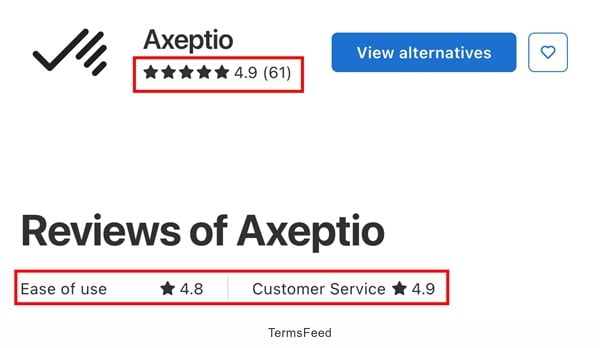
Human support is consistently praised across Capterra, G2, and GetApp. Reviewers describe response times as fast and team members as knowledgeable and proactive.
- High Consent and Opt-In Rates (from 72% to 80% in Case Studies). Gites de France Corsica reported a 72% consent rate after implementing Axeptio with Google Consent Mode v2. Speedway reached an average interaction and consent rate of around 80%.
- Deep Brand Customization (Video, Motion Design, Custom Typography). Brands have full control over colors, fonts, illustrations, animations, and tone of voice. Many platforms require code to reach this level of customization.
- No-Code Platform Accessible to Non-Technical Teams. Marketing and brand teams manage the consent experience without developer involvement. Updates take effect immediately without a code deployment.
- Excellent Shopify and E-commerce Integration. The Axeptio app can be enabled for Spotify with a simple widget. PrestaShop and WooCommerce integrations are mature and well-maintained. E-commerce consent is a particular strength.
- Lightweight and Fast. The mobile SDK footprint is under 2 MB. Axeptio engineers the CMP script to minimize impact on Core Web Vitals and page load times.
- Comprehensive Multi-Regulation Compliance. GDPR, CCPA, PIPEDA, Law 25, nFADP, LGPD, and ePrivacy are all covered from a single configuration.
- EU Data Sovereignty (French Company, European Data Handling). Axeptio processes and stores consent data in the EU. However, some subcontractors are outside the EU. Axeptio applies technical and organizational measures to make transfers safe. For European businesses, this removes the data transfer concerns that arise with US-based CMPs.
- Timestamped Consent Proof Storage for Audits. Axeptio records every consent event with a timestamp and the policy version in effect. This supports the GDPR requirement to demonstrate lawful consent.
-
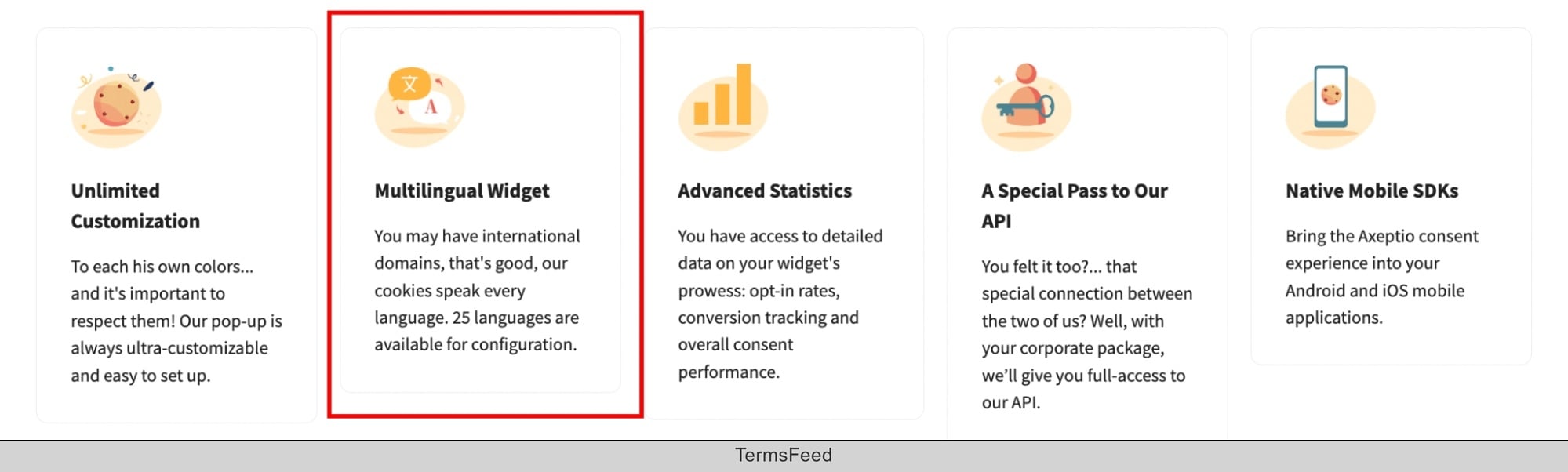
Multi-Language Support (25+ Languages). Banners display in over 25 languages. Geo-targeting applies the correct language automatically based on visitor location.
The image below shows this.
- Dedicated Publisher Offering with TCF Revenue Optimization. Axeptio for Publishers includes IAB TCF v2.3 support and a configurable vendor list to maximize ad revenue while staying compliant.
- Active Company Momentum (Acquisitions, New Markets). Axeptio acquired AdOpt in Brazil (February 2025) and CookieCode in the Netherlands (July 2025). The company opened a Montreal subsidiary in early 2025 and received ISO/IEC 27001 certification in January 2026.
- Good Value at Mid-Tier Pricing. The Medium plan at €69 per month (80USD) covers 100,000 pageviews, analytics connectors, and the Consent Wall. For e-commerce and media sites at this traffic level, this is good value.


What are the Cons of Axeptio?
The cons of Axeptio are forced branding on lower tiers, price increases over time, a limited free offering, and gaps in analytics depth and developer flexibility.
- Axeptio Logo Required on Lower-Tier Banners. The Axeptio brand appears on consent banners for lower-tier subscribers. Brands that need a fully unbranded experience need a costlier plan.
-
Significant Price Increases Over Time (Since 2021). Multiple user reviews on G2 and Capterra note substantial price increases since 2021.
The review image from G2 shows this below.
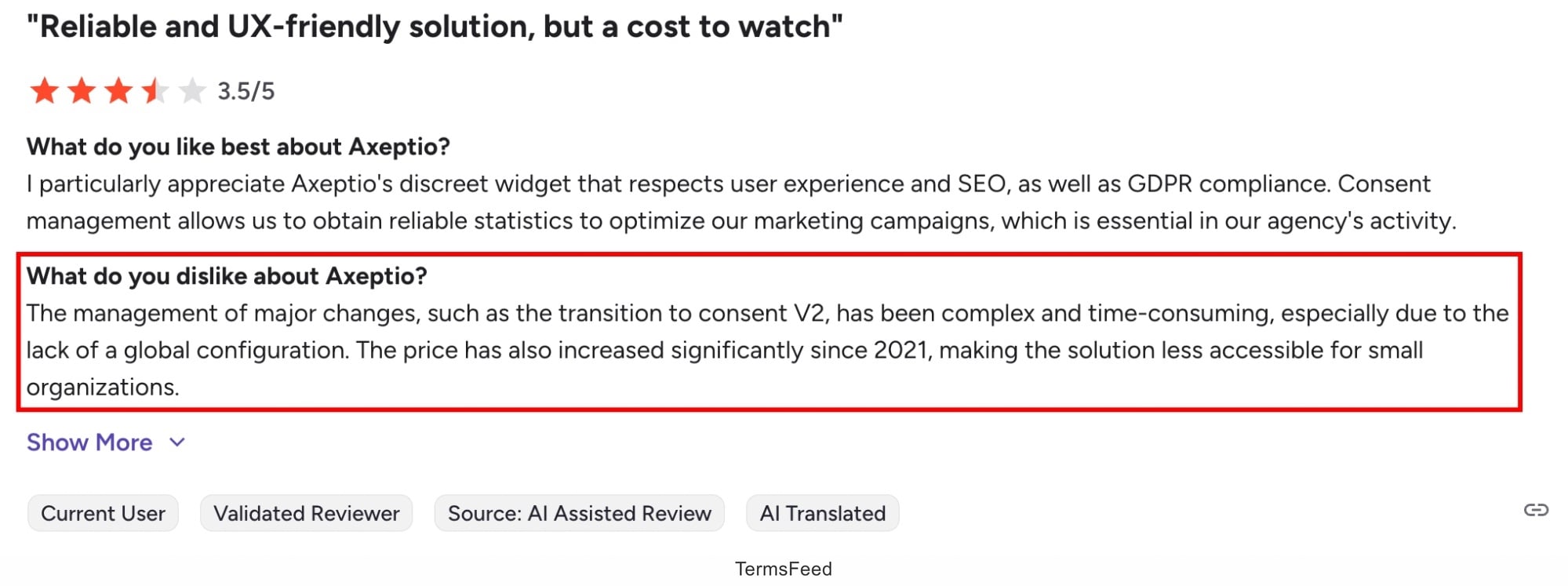
Some users report price changes without advance notice. This makes the platform less accessible for smaller organizations.
- Very Limited Free Tier (200 Visitors/Month Cap, Limited Features). The free plan covers 200 visitors per month. For any site with significant traffic, the free trial is not usable.
- Missing Intermediate Pricing Tier (Big Jump from Free to €29/Month). There is no plan between free and €29 per month.
-
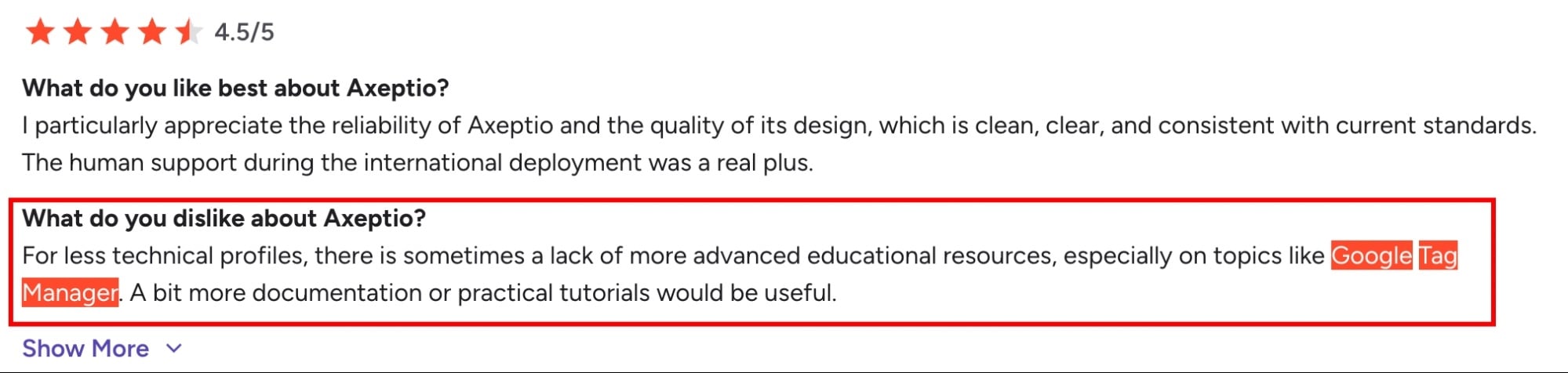
Documentation Hard to Navigate for Advanced Setups. Basic setup documentation is clear. G2 reviewers note a lack of advanced educational resources, particularly on GTM topics.
The image below shows this.
- Shallow Analytics (No Per-Cookie Granularity). The dashboard shows overall consent rates but not acceptance rates per individual cookie category. Axeptio is not suitable for users who need cookie-level insight.
-
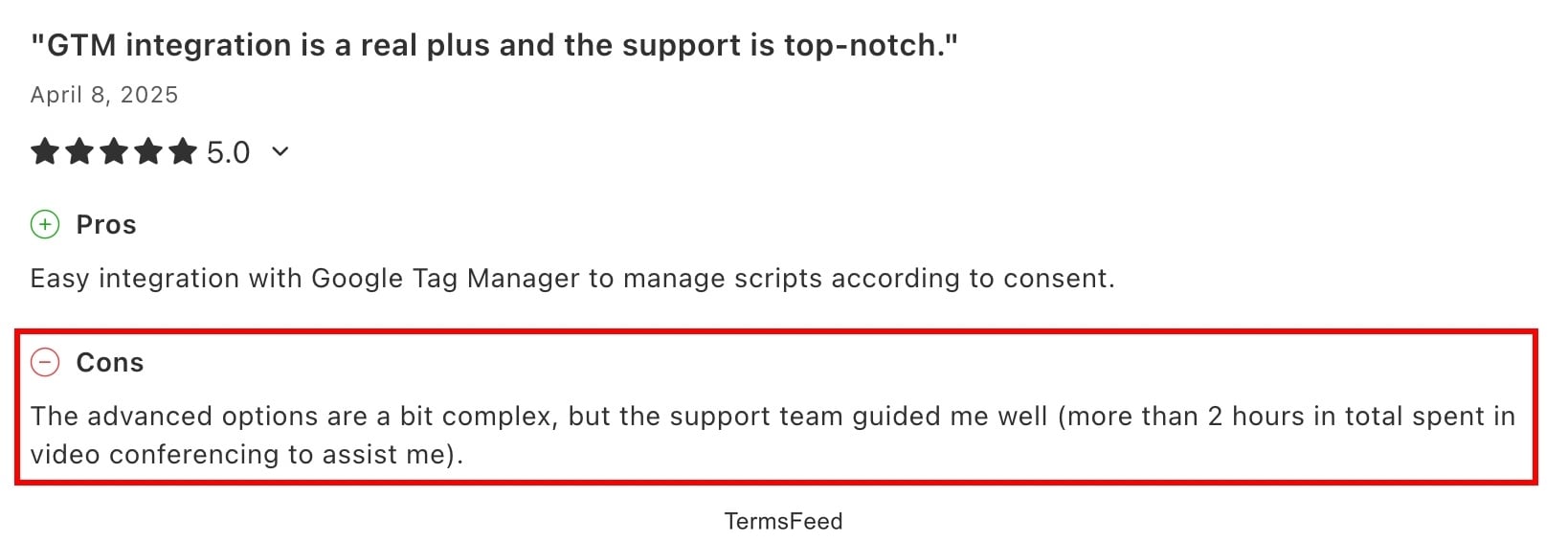
Complex Google Tag Manager Setup for Advanced Use Cases. Standard GTM deployment is straightforward. Advanced consent trigger configurations require GTM knowledge. Some users report spending significant time on this.
The image below shows this.
- Tedious Multi-Language Configuration Management. Supporting multiple languages requires configuring each language version of the banner separately, which is time-consuming.
- No Seasonal or Traffic-Based Billing. Sites with seasonal traffic spikes either upgrade to the next plan tier or risk exceeding their monthly pageview allowance. No temporary plan adjustments are available.
- Unclear Agency Offer Terms and Conditions. The Axeptio agency page describes the Agency plan as requiring a demo call, after which pricing is established. This means it is unclear before the demo what the offer costs.
- Limited Commercial Flexibility on Pricing Negotiations. Axeptio does not offer significant pricing flexibility for standard plans. Custom rates require moving to an Enterprise or Agency plan.
- Limited Advanced Customization for Developers Beyond No-Code Builder. Developers who need more than the visual builder find the API and developer documentation less mature than the user-facing product.


What are the alternatives to Axeptio?
The alternatives to Axeptio are TermsFeed, Cookiebot, Didomi, OneTrust, CookieYes, Usercentrics, Termly, Osano, iubenda, CookieFirst, Enzuzo, Quantcast Choice, Sourcepoint, Piwik PRO, Complianz, Consentik, CookieScript, Gravito, Cytrio, and heyData.
TermsFeed is the strongest alternative for businesses that need legal document generation alongside compliance.
For businesses that only need consent banner management, the CMPs listed below are direct alternatives to Axeptio.
These tools are described in more detail below.
-
TermsFeed. TermsFeed is a legal document generator that produces Privacy Policies, Terms and Conditions, Cookie Policies, Disclaimers, EULAs, and Return and Refund Policies. The image below shows examples of TermsFeed policies, including the Privacy Policy Generator, which Axeptio does not offer.
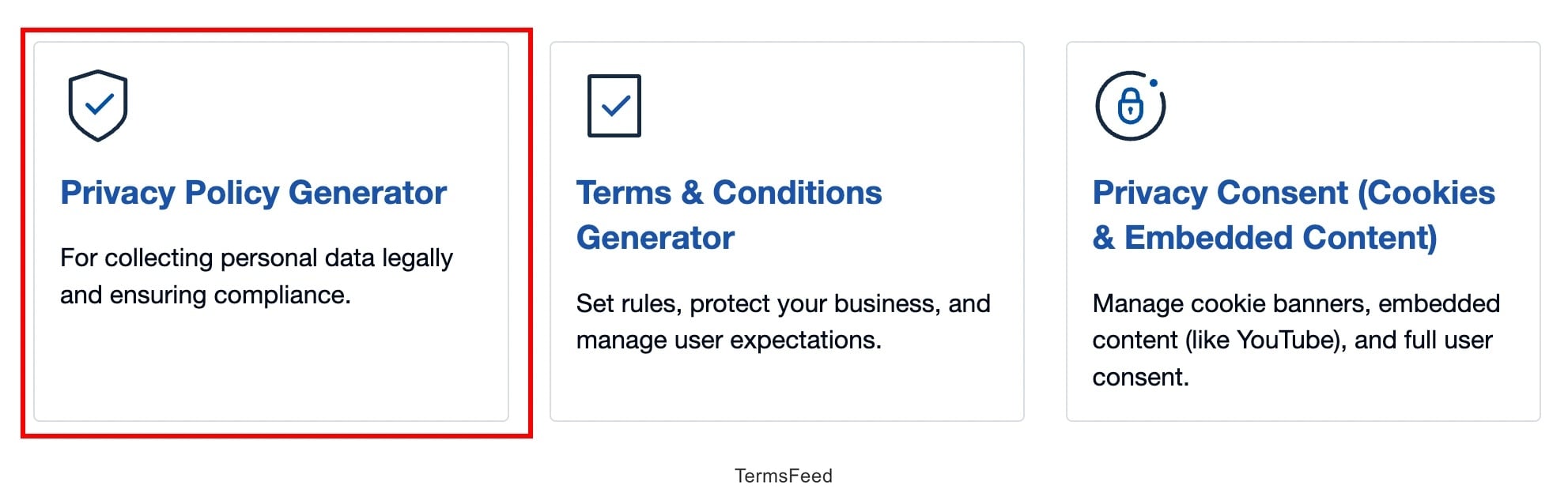
TermsFeed includes a basic cookie consent banner, and is available across a number of jurisdictions. The image below shows these jurisdictions.
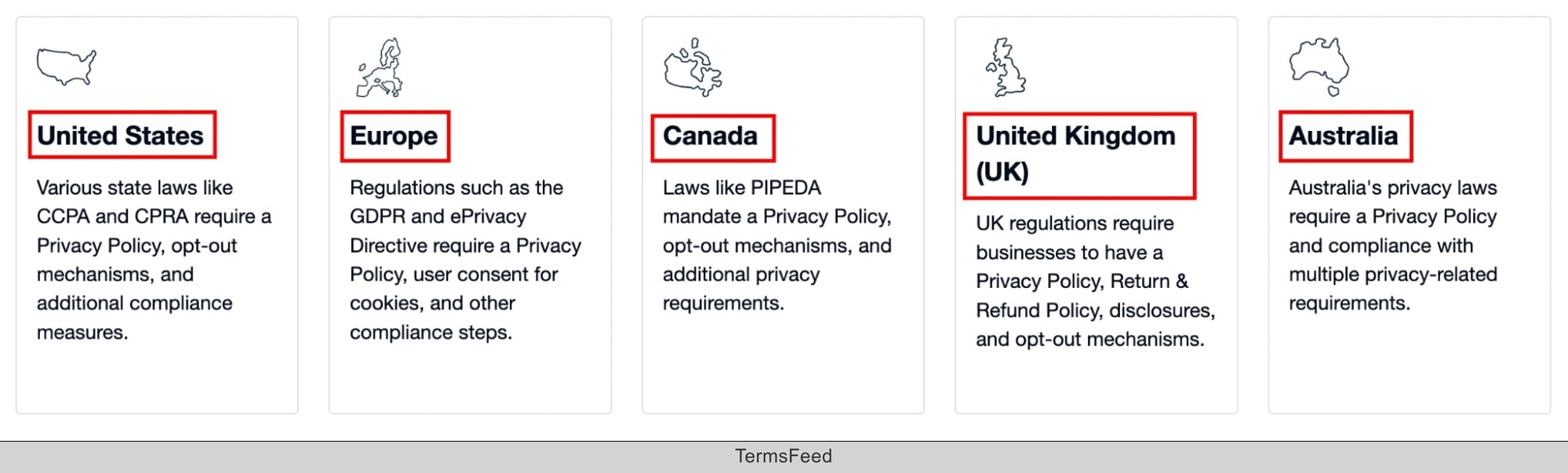
TermsFeed is the best alternative to Axeptio for 2 types of users. The first is smaller websites that need privacy compliance without a monthly CMP subscription. TermsFeed provides the legal documents and a working consent banner at a lower cost.
The second is businesses already using Axeptio who need legal documents that the consent banner links to. Axeptio manages consent to those documents. TermsFeed generates them.
- Cookiebot is a pure CMP with automated cookie scanning and geo-targeted consent banners. This is useful for sites that need reliable automatic cookie detection and a compliance-focused banner without the UX features of Axeptio. Cookiebot is owned by Usercentrics (below).
- Didomi is an enterprise CMP with advanced analytics, preference centers, and multi-channel consent management. It is a good alternative for large organizations that need greater scalability and analytics depth than Axeptio provides.
- OneTrust is a full enterprise privacy suite covering consent management, data subject requests (DSRs), data processing impact assessments (DPIAs), and data mapping. This is a solid tool for enterprises that need a complete privacy program rather than just a consent banner.
- CookieYes is a CMP with a free tier, cookie scanning, and a basic cookie policy generator. CookieYes is useful for small businesses that want a free starting point with basic cookie policy generation.
- Usercentrics is an EU-based CMP with IAB TCF support, A/B testing, and detailed consent analytics. It is a good alternative for publishers and brands that need detailed analytics and strong EU compliance credentials.
- Termly offers 10 policy generators alongside a CMP and a free tier. Termly is good for businesses that want to combine policy generation and consent management in one tool, with more policy types than Axeptio offers.
- Osano is a consent management platform. Osano is suitable for larger organizations that need consent management alongside vendor risk tracking and compliance monitoring.
- Iubenda offers Privacy Policy and Cookie Policy generation alongside a cookie consent solution. It is a good alternative for EU-focused businesses that want policy generation and consent management in one platform.
- CookieFirst is a CMP that includes an automatically updated cookie table embedded directly in a Privacy Policy. CookieFirst suits sites that want auto-updating cookie documentation alongside the consent banner.
- Enzuzo offers AI-powered privacy policy generation alongside a CMP and data subject request management. Enzuzo makes sense for growing businesses that want AI-assisted compliance automation.
- Quantcast Choice is a free TCF-certified CMP designed for publishers. This is a solid choice for digital publishers that need a free, IAB-certified consent solution.
- Sourcepoint is a publisher-focused CMP with deep integration into programmatic ad tech and SSPs. It is useful for large digital publishers that need consent management tightly integrated with advertising monetization.
- Piwik PRO is a privacy-first analytics platform with a built-in consent manager. Piwik PRO is suitable for organizations switching away from Google Analytics who want analytics and consent management in a single EU-hosted platform.
- Complianz is a WordPress plugin that handles cookie consent and cookie policy generation natively within WordPress. It is a good alternative for WordPress site owners who want deep native integration without deploying a separate CMP.
- Consentik is a CMP available for Shopify and small sites. It is useful for Shopify stores that dont want the full Axeptio feature set. It is a Google CMP Partner, covers Shopify and Wix, supports 40+ languages, and has a full statistics dashboard.
- CookieScript is a CMP with cookie scanning, geo-targeting, and basic policy generation. The Lite plan of CookieScript starts at $8 per month. This makes it a good alternative for budget-conscious sites that find the Axeptio entry price too high.
- Gravito is an enterprise-level CMP focused on Nordic markets. Gravito has identity resolution capabilities, edge data processing, cross-domain consent bridging, and a developer-focused API architecture. It is well-suited to Scandinavian businesses with region-specific compliance requirements.
- Cytrio is an all-in-one platform that includes a consent manager, a data subject access request manager, a policy generator, and an audit trail. It is a good alternative for small to mid-sized businesses that need consent management and rights request handling in a single affordable platform.
- heyData is a GDPR management and employee training platform for small- and medium-size businesses. It makes sense for businesses that want broader compliance coverage beyond cookie consent.


What is the history of Axeptio?
The history of Axeptio is the story of a French startup that identified cookie consent as a UX problem.
Axeptio built a platform around the idea that compliance and brand experience are not conflicting.
Axeptio was founded in 2018 in Montpellier, France. The company launched a Software as a Service (SaaS) cookie consent solution in 2018, and joined the Facebook Startup Garage accelerator the same year. The leadership team includes Romain Bessuges-Meusy (CEO), Delphine Dorseuil (CFO), Christophe Landat (CLO), Laurent Thomas, and Guillaume Diep.
Further key milestones:
- 2021 to 2023: Expanded with the Taste browser extension and Terms Widget
- May 2023: Raised EUR 3.5 million from ISAI, OVNI Capital, and Evolem
- 2024: Achieved Google CMP Partner Gold status. Launched Axeptio for Publishers. Expanded to Quebec
- Early 2025: Opened Montreal subsidiary for the Canadian market
- February 2025: Acquired AdOpt (Brazil) for LGPD market entry
- July 2025: Acquired CookieCode (Netherlands)
- January 2026: Received ISO/IEC 27001 certification
- March 2026: Won the Tech Prize at the CFNEWS Growth Awards
Axeptio currently employs 50+ people across offices in Montpellier, Paris, Montreal, the Netherlands, and Brazil. The platform serves more than 80,000 websites and has stored over 10 billion consent records.

The first step to compliance: A Privacy Policy.
Stay compliant with our agreements, policies, and consent banners — everything you need, all in one place.


