


AI Summarize


Share


It's a common misconception that having an open source brand means you can't enforce trademark rights. However, open source licensing applies to code, not branding, and open source doesn't mean that your brand name and logo are free for anyone to use.
Companies can work with open source software and remain committed to open source principles while taking steps to protect their brand through the use of trademarks, effective policies, and legal remedies.
This article explains what open source software and trademarks are, resolves common myths about the relationship between open source and trademark rights, and includes a comprehensive guide on how to protect your open source brand.
- 1. What Is Open Source Software?
- 2. What Is a Trademark?
- 3. What Is the Relationship Between Open Source Software and Trademark Rights?
- 3.1. Quick comparison: code rights vs. brand rights
- 3.2. Myth #1: Using an Open Source License Keeps People From Using Your Project's Name
- 3.3. Myth #2: Trademark Enforcement Conflicts With Open Source Values
- 3.4. Myth #3: Trademarks Must Be Registered to Be Enforceable
- 3.5. Myth #4: You Can't Provide Open Source Copyrights and Enforce Your Brand's Trademark
- 3.6. Myth #5: I can licence my mark loosely without supervision and still retain full trademark rights
- 4. What Counts as an Open Source Brand Trademark Violation?
- 5. How to Protect Your Open Source Brand
- 5.1. How to Register a Trademark for an Open Source Brand
- 5.2. What Happens After You've Filed Your Trademark Application?
- 5.3. How Long Does Your Trademark Last?
- 5.4. Does USPTO Trademark Registration Protect Your Brand Internationally?
- 6. How to Create an Effective Open Source Trademark Usage Policy
- 6.1. Definition
- 6.2. Ownership of Trademark Rights
- 6.3. Permitted and Restricted Uses
- 6.4. Brand Use Guidelines
- 7. Where to Put Your Trademark Usage Policy
- 8. How to Create a Sublicensing Agreement
- 9. How to Monitor Trademark Compliance
- 10. What to Do If Someone Misuses Your Open Source Brand
- 10.1. 1. Contact the Infringing Party
- 10.2. 2. Send a Cease-and-Desist Letter
- 10.3. 3. File a Domain Dispute Complaint
- 10.4. 4. File a Trademark Complaint
- 10.5. 5. Take Legal Action
- 11. Checklist for Open-Source Brand Enforcement
- 12. Summary
What Is Open Source Software?
Open source software is software that can be accessed, used, modified, and shared by anyone.
The reasons businesses choose open source software for their brands can include:
- Company values align with the open source principles of freedom, community, transparency, and collaboration.
- When there are many people continuously working on software, bugs can be easier to find and fix, resulting in more stable software over time.
- Reusing existing code instead of developing code from scratch can help businesses save time and money.
The Open Source Initiative (OSI) explains that open source software is software that can be used, accessed, changed, or shared (in either original or modified form) by anyone, and is distributed under open source licenses.

Remember, open source doesn't necessarily mean open brand. Open source licensing gives users the right to access and use your open source code, but it does not mean that other people can use your brand or logo however they please. Trademark law protects your brand name, logo, and other brand identifiers.
What Is a Trademark?
A trademark can be a word, symbol, design, or phrase (or a combination of these) that identifies your business's goods or services.
Trademarks serve to identify the source of your goods or services, and provide legal protection for your brand.
Having a trademark does not mean that you legally own a specific word or phrase and can keep other people from using it. Your trademark rights only extend to how your name or logo is used in connection with your goods or services. It means you have exclusive rights in your goods/services class and territory, subject to defences such as fair use and prior rights.
For instance, having a trademarked name for your bookstore wouldn't necessarily prevent a coffee shop owner from using the same name for their business.
The United States Patent and Trademark Office's (USPTO) What is a trademark? page explains that trademark rights kick in as soon as you start using your trademark in connection with your goods or services, but that registering your trademark can give you broader and more enforceable rights.

The USPTO also explains that common-law rights are generally limited to the geographic area of actual use and are harder to enforce nationally.
What Is the Relationship Between Open Source Software and Trademark Rights?
Let's take a look at a few common misconceptions about the relationship between open source software and trademark rights.
Quick comparison: code rights vs. brand rights
| Topic | Open-source license (e.g., Apache-2.0/GPL) | Trademark (brand name/logo) |
| What it covers | Code: use, copy, modify, distribute | Brand identifiers: names, logos, wordmarks |
| Granted rights | Copyright (and sometimes patent) rights | Right to indicate source; prevent confusing use |
| Key clause | Apache-2.0 grants copyright/patent but not trademarks | Trademark policy/license governs any brand use |
| Can a fork use it? | Yes, the code (per license) | Only if allowed by trademark policy/license; otherwise must rebrand |
| Risk if unmanaged | — | Naked licensing/dilution → loss of rights |
Myth #1: Using an Open Source License Keeps People From Using Your Project's Name
Releasing a project under an open source license does not automatically give the licensor the right to prevent other people from using the project's name.
Trademark rights come from trademark law, either through trademark registration or common law usage, not open source licenses. Keep in mind that a trademark license protects open source identifiers (such as names, brands, and logos), not code.
Many open-source projects keep code open while strictly controlling their names and logos through trademark policies (e.g., OSI's trademark guidelines).
The OSI's FAQ page explains that many open source projects enable other people to use their code while still maintaining control over their trademarks.

Myth #2: Trademark Enforcement Conflicts With Open Source Values
Trademark enforcement is not at odds with open source principles. You can enforce your trademark and still be considered open source as long as you are not restricting software freedom.
When you trademark your brand, you restrict how other people can use your brand or logo, but the trademark doesn't affect how people can use your project's open source code. The open source license dictates how other people can use your open source code, while trademark law controls how they can use your brand or logo.
The Mozilla Trademark Guidelines explain that while Mozilla is an open source business that makes its code publicly available, its names, brands, and logos are all protected by trademarks.

For a concise explanation of why trademark enforcement doesn't restrict software freedom, see Google's Open Casebook on "Trademarks in Open Source".
Myth #3: Trademarks Must Be Registered to Be Enforceable
Trademarks can still be enforceable even if they aren't formally registered. Unregistered (common-law) rights may exist, but they are generally limited to the geographic area of actual use and may be harder to enforce globally
There are two ways to activate trademark rights under trademark law, either through officially registering your trademark via the USPTO in the US, or through commercial use. However, common law trademark rights typically only apply to the geographic area where your trademark is used.
The USPTO's Why register your trademark? page explains that while official trademark registration is not required, common law rights only apply to the specific geographic area where the trademark is used, and will not show up in the USPTO search database.

Myth #4: You Can't Provide Open Source Copyrights and Enforce Your Brand's Trademark
Licensing trademark rights is a different process from licensing copyrights and patents. While copyrights and patents protect creative works and inventions, trademarks are designed to protect the source of a product or service. You can openly license your brand's copyrights and patents and enforce your brand's trademark.
The open source Apache 2.0 license grants users copyright and patent licenses, but does not grant trademark rights:

Section 6 states: "This License does not grant permission to use the trade names, trademarks, service marks, or product names of the Licensor…":

Myth #5: I can licence my mark loosely without supervision and still retain full trademark rights
You must build quality control into any trademark licenses to avoid ‘naked licensing'.
Allowing third parties (including forks, distributors or community projects) to use your trademark without adequate quality-control or oversight may result in "naked licensing" and lead to abandonment of your rights. As explained in the open-source context:
"Naked licensing" occurs when a licensor "fails to exercise adequate quality control over the licensee … and consequently… the trademark owner has abandoned the trademark.'
Courts treat inadequate quality control as potential abandonment ("naked licensing"), so written quality-control provisions and actual oversight matter. In the case Neo4j Inc v. PureThink LLC (2020), a U.S. district court rejected the defence that open-source licensing alone caused abandonment, and reaffirmed the importance of active oversight and control.
For open-source brand owners, that means your Sublicensing Agreement or usage policy must include clear quality-control, inspection and termination rights (see below). Failing to monitor how third parties use your trademark may weaken your mark's distinctiveness in the long run.
What Counts as an Open Source Brand Trademark Violation?
If someone creates a fork (technical copy) of your open source project and renames it so that it's not using your brand or logo, that's all in the spirit of open source.
However, trademark violations can occur if someone uses your name or logo, or a similar version, in a way that could confuse users about the source of the brand. This includes cases where they are promoting a derivative or forked version of your open source brand.
For example, in September 2024, Matt Mullenweg, the owner of the open source brand WordPress, alleged that WP Engine use of "WordPress/WP" trademark created confusion and required a trademark license. WordPress.org also stated WP Engine ‘needs a trademark license.'

Examples of forked versions of open source brands that chose their own distinct names and logos to respect trademark boundaries include MariaDB and LibreOffice.
MySQL and MariaDB are both open source relational databases. MySQL employs a dual-licensing model, offering software under the open source GPL, as well as features available under proprietary license subscriptions. MariaDB started out as a fork of Oracle-owned MySQL but distinguishes itself by guaranteeing that it will stay open source.
The MariaDB Foundation website lets users know that it will remain licensed as free and open source software under GPLv2.

LibreOffice is a fork of OpenOffice that chose a new name and logo to respect OpenOffice's trademark rights.
LibreOffice's website footer includes copyright, open source license, and trademark information, and lets users know that it is based on OpenOffice.

How to Protect Your Open Source Brand
While you can't keep people from creating forks of your open source code, you can control how your brand, names, and logos are used by enforcing your trademark rights and establishing clear Trademark Usage Policies and Sublicensing Agreements.
Let's start by taking a look at the step-by-step process for registering a trademark for your brand.
How to Register a Trademark for an Open Source Brand
Follow these steps to license a trademark for your open source brand:
- Determine whether you need a trademark. A trademark is specifically for protecting brand names and logos that are used for goods or services. If you want to protect your invention, you'll want to apply for a patent. If you have an original creative work, such as a literary or artistic work, you'll want a copyright.
- Determine whether you can register your trademark. If your trademark is generic, or if someone else already claimed rights to a similar brand, name, or logo, you may not be able to register your trademark. Searching the USPTO database can help you find out if there are any similar registered trademarks for related goods or services.
- Identify your trademark format. Your trademark format can be a standard character mark, stylized/design/"special form" mark, or a sound mark.
- Identify the goods and services that will be used with your trademark. You can enter search terms in the USPTO Trademark ID Manual to determine what class your goods or services belong to.
- Identify your application filing basis. There are four filing bases from which you can choose: Use in commerce basis (if you currently use your mark to sell your goods or services), intent-to-use basis (if you intend to use your trademark in commerce soon), foreign registration basis (if you own a foreign registration of the same trademark for the same goods or services from your country), and foreign application basis/ foreign priority basis (if you own a foreign application that was filed within six months of your U.S. application for the same trademark for the same goods or services).
- Hire an attorney. If you are foreign-domiciled, you will need to have a U.S. attorney. While not required if you're based in the U.S., the USPTO does recommend having a U.S. attorney who practices trademark law to help you through the trademark application process.
- File your trademark application in the Trademark Center. Sign up for and log in to your USPTO account to access the Trademark Center.
If you file outside the U.S., many national offices follow broadly similar steps, selection of mark, classification of goods/services, examination, publication, opposition period, and registration. For EU-wide unitary protection, see the EUIPO overview of EU trade marks; the EUTMR confirms the unitary character of the EUTM.
What Happens After You've Filed Your Trademark Application?
Once you have completed the steps listed above, the USPTO will review your application. Be aware that this process can take several months, so it's a good idea to file your trademark application as soon as possible.
If your application is not approved, you will receive a letter explaining why it was rejected, and you will have three months to respond to the letter before your application is considered abandoned.
If your application is approved, the USPTO will publish your trademark in the Trademark Official Gazette, a weekly online USPTO publication. Once the trademark is published, anyone who believes the registration of your trademark could cause them damage has 30 days from the date of publication to submit an opposition to your registration.
The edition of the Trademark Official Gazette for the week of November 4, 2025, publishes trademark information, including case identifiers, mark information, and goods and services information.

If there is no opposition, the USPTO will register your trademark and send you a certificate of registration (if your trademark is based on use).
How Long Does Your Trademark Last?
Your trademark can last indefinitely if you keep using the mark and file the required USPTO maintenance renewals. It can last indefinitely, but you must continue to use your trademark in commerce and file maintenance documents to keep your registration active.
The USPTO Keeping your registration alive page explains that failure to file required maintenance documents on time can result in the cancellation or expiration of your trademark registration.

Does USPTO Trademark Registration Protect Your Brand Internationally?
USPTO trademark registration protects your brand within the U.S. You can register your trademark internationally by using the Madrid Protocol. The Madrid Protocol enables trademark owners to register and manage their trademarks in over 120 countries through a single application.
The USPTO's Outbound Madrid Protocol applicants page lists the eligibility requirements for filing an international application through the USPTO, including having either a U.S. trademark registration or pending application and being a U.S. national, having a U.S. domicile address, or having an industrial or commercial establishment in the U.S.

While the overview above focuses on the U.S. system, brand owners of open-source projects operating in or serving the European / global market should also account for European and international trademark structures. Under the European Union Intellectual Property Office (EUIPO) regime, the European Union Trade Mark (EUTM) offers unitary protection across all EU Member States. Moreover, the Madrid Protocol facilitates international registration of marks in over 120 member territories via a single application.
In addition to registration, enforcement in Europe requires consideration of the EU's enforcement framework (e.g., Regulation (EC) No 608/2013 on customs measures, and the role of the European Observatory on Infringements of Intellectual Property Rights).
From an open-source brand perspective, this means you should determine key jurisdictions of use or service, register your mark (or plan to) in those jurisdictions, and monitor uses globally.
How to Create an Effective Open Source Trademark Usage Policy
Creating an effective Trademark Usage Policy for your open source brand comes down to explaining who owns trademark rights and how other people are allowed to use your brand name, logo, or other identifiers.
An effective Trademark Usage Policy typically includes information about:
- What a trademark is
- Who owns trademark rights
- Permitted and restricted uses of your brand, logo, and other identifiers
- Brand use rules
Let's take a closer look at each clause and what it covers.
Definition
This clause informs users about what a trademark is and how it works. Some companies provide or link to a list of trademarks and logos within this section.
Progress Software Corporation's (PSC) Trademarks Use Policy explains what trademarks and service marks are and lets users know that it owns both registered and unregistered trademarks.

Ownership of Trademark Rights
This clause lets users know who owns trademark rights. You can use this section of your Trademark Usage Policy to describe restricted uses, or provide that information under a separate clause.
Reddit's Trademark Use Policy lets users know that it owns its trademark and other brand assets and explains that they are not allowed to use identical or confusingly similar marks or domains or use trademarks or assets in a way that suggests affiliation, endorsement, or sponsorship, or violates Reddit policies.

Permitted and Restricted Uses
Your Trademark Usage Policy needs to clearly explain what people can and can't do with your brand name, logo, and other identifiers.
PSC's Trademark Use Policy lets users know that they can use its names, trademarks, and service marks to identify the company and its products and services, but that use cannot suggest that PSC endorses, sponsors, or is affiliated with other companies, products, or services. It goes on to say that PSC marks cannot be combined with other business names, trademarks, or identifiers, and that confusingly similar trademarks, logos, and other identifiers are prohibited.

CMS Made Simple's Trademark Use Policy allows open source projects to use its trademark under certain circumstances, but written permission is required for restricted usage, including commercial use, derivative works, and use in marketing purposes.

Brand Use Guidelines
This clause helps you control your brand by providing guidelines for how people can use your brand and logo.
Brand use guidelines can explain what happens when a project is forked and who can use the original name. Open source companies may encourage forking, as long as the forked projects choose names that clearly set them apart.
WordPress's Forking is Beautiful page encourages users to create their own forks of WordPress and contains a list of WordPress forks. However, the list includes one fork WordPress doesn't recommend WP Engine due to confusion around its name.

WordPress's Trademark Policy explains that users must meet its criteria and get permission from the WordPress Foundation in order to use its name or logo.

Reddit's brand guidelines page includes rules about how to use its trademarks, logos, and other brand assets, and what constitutes misuse, and is linked within its Trademark Use Policy.

Where to Put Your Trademark Usage Policy
Once you have your Trademark Usage Policy written, it's important to put it somewhere people can easily find it. You can maintain your Trademark Usage Policy as a standalone page on your website and provide a link to it in an accessible location, such as within your website footer.
Linux maintains a link to its Trademark Usage Policy alongside its Privacy Policy within its website footer.

How to Create a Sublicensing Agreement
In addition to a Trademark Usage Policy, if you offer sublicensing, it's important to have a Sublicensing Agreement that explains how sublicensees can use your trademark.
Sublicensing in the context of trademark usage is when you provide a licensee with the right to use your trademark. Your sublicense may, under certain conditions, permit the licensee to authorize others to use your trademark as well.
For example, Linux's Sublicense the Linux Mark page explains that it offers sublicensing to approved users who agree not to challenge trademark ownership and to properly attribute ownership. It includes links to its sublicense application page and Sublicense Agreement, where users can learn more about sublicensing its trademark.

A Sublicense Agreement typically includes clauses such as:
- Sublicense grant. This clause explains that you are granting the sublicensee the right to use your trademark in connection with their goods or services.
- Termination. The termination clause explains how long the sublicensee's rights last and the circumstances under which the sublicense can be terminated.
- Requirements. This clause lets sublicensees know the rules they must follow in order to use your trademark.
- Authorized uses. This clause explains how the trademark can be used.
- Trademark protection. It's important to include a clause that lets sublicensees know that they can't challenge your trademark ownership.
- Disclaimer. A disclaimer of warranties and liabilities explains that you make no warranty regarding the use of the trademark and are not liable for any damages that may occur from the sublicensee's use of the trademark.
- Governing law. This clause informs sublicensees what laws apply to the sublicense.
Linux's Sublicense Agreement explains that sublicensees must include a legend on all their goods, services, and accompanying literature that lets customers know that the trademark belongs to Linux and that they cannot challenge Linus Torvald's trademark ownership.

Keep in mind that sublicensing can make it harder to control how your brand is used. Sublicensing can lead to naked licensing, which is when a trademark owner lets others use their trademark but doesn't adequately control how the trademark is used, or trademark dilution, which is when the strength of a trademark is diminished by connecting it to something that doesn't align with your brand values.
If you choose to sublicense your open source brand, you should have quality control rules in place and take steps to monitor compliance.
How to Monitor Trademark Compliance
Once you have established your Trademark Usage Policy, you should have a plan for monitoring compliance.
Following these steps can help you protect your trademark from infringement:
- Conduct online monitoring. Setting up Google Alerts, regularly checking social media platforms, running reverse image searches to find use of your logo, and using automated monitoring tools like Hootsuite or Brandwatch can help you detect unauthorized use of your trademark.
- Subscribe to a trademark watch service. Trademark watch services such as Clarivate or Corsearch can help you protect your brand by watching websites, apps, domain names, and USPTO pending applications and the USPTO Official Gazette for similar trademarks.
- Regularly check the USPTO and international trademark databases. You can conduct regular USPTO trademark searches to check for similar applications or registrations.
- Monitor domain name registrations. You can check domain registration databases for unauthorized use of your trademark or brand name.
Additional points for your brand monitoring strategy:
- Consider using a formal trademark-watch service (e.g., Clarivate, Corsearch) to track newly-filed applications and domain registrations across jurisdictions.
-
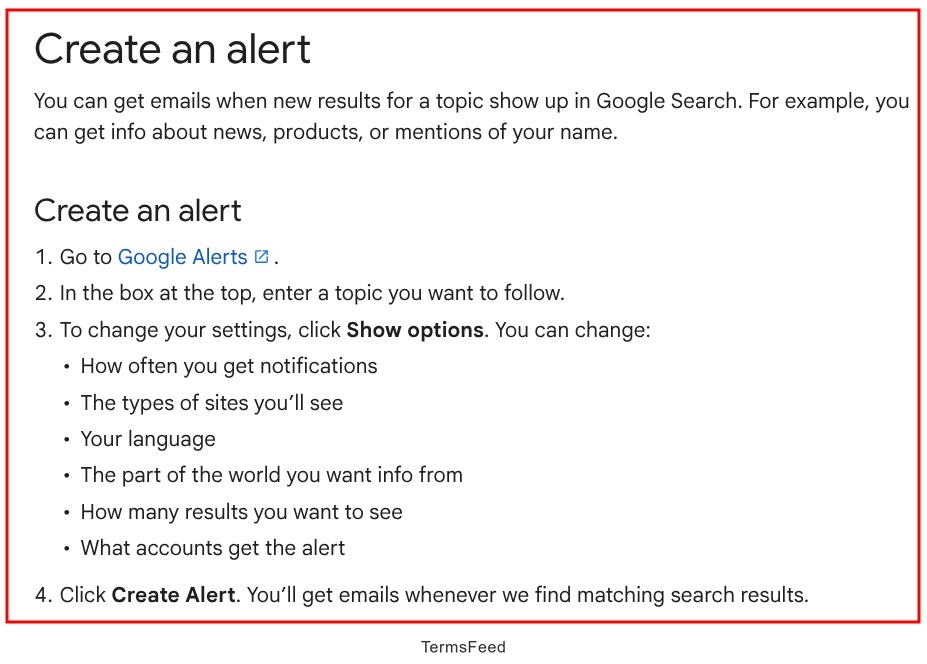
Set up keyword + reverse-logo image alerts via tools such as Google Alerts and reverse image-search platforms.
The Google Help Center page explains how to set up a Google Alert, which can send you an email whenever mentions of your brand show up in Google Search.
- Allocate budget and resources: while free tools help initially, global brand owners should plan for annual maintenance, watching services, and potential enforcement costs.

As one commentary advises, proactive policing is critical: "To mitigate the risk of abandonment by naked licensing, a trademark owner should be proactive by entering into a written agreement … that imposes quality control standards."
What to Do If Someone Misuses Your Open Source Brand
If someone misuses your open source brand, there are several steps you can take to protect your open source brand, including:
- Sending an informal request
- Sending a cease-and-desist letter
- Filing a domain dispute complaint
- Submitting a trademark complaint
- Filing a trademark infringement lawsuit
Let's take a look at how you can implement these steps to protect your open source brand.
1. Contact the Infringing Party
Typically, you want to start by reaching out to the person or company to let them know that they are misusing your brand. They may be unaware that their activities go against your brand rules, and it can save you time and money (and help you build community) to try communication and diplomacy tactics before going straight to the big guns and filing a lawsuit.
Sending a polite request to stop the infringing issues may be all you need to do to resolve misunderstandings.
2. Send a Cease-and-Desist Letter
If the offending party doesn't respond to your initial notice or doesn't stop the infringing issue, then you can send a cease-and-desist letter.
A cease-and-desist letter is a formal demand that the infringing party stop unauthorized use. Many companies hire an attorney to write an official cease-and-desist letter, but you can also write your own.
Here's how:
- Include your trademark registration, or date of first use, and the products or services that are associated with your trademark.
- Explain the infringing activities and include evidence (such as a screenshot).
- Let the infringing party know exactly what you want them to do and their response deadline.
- Explain what will happen if the infringing party doesn't comply with your demands.
If the infringing party doesn't respond to or fully comply with your cease-and-desist letter, you may need to take legal action.
3. File a Domain Dispute Complaint
If you believe another company is using a domain name that violates your trademark, you can use the Uniform Domain Name Dispute Resolution Policy (UDRP) to file a domain dispute complaint with the World Intellectual Property Organization (WIPO).
The UDRP is a legal framework designed to resolve disputes between trademark owners and domain name registrants. Trademark owners worldwide can submit a UDRP complaint about domain names that potentially violate their trademark via an online form.
The WIPO Guide to the Uniform Domain Name Dispute Resolution Policy (UDRP) page explains that users can submit a complaint by downloading and filling out a Model Complaint and paying for and submitting the complaint through an Online Form.

4. File a Trademark Complaint
You can file a trademark infringement complaint on platforms such as GitHub, YouTube, and Google Ads, in app stores, and on social media platforms. You can also file a notice of opposition or a petition to cancel a trademark registration with the USPTO.
GitHub's Trademark Policy Page explains that users can report suspected trademark violations by submitting a Trademark Policy Violation Report.

Similarly, the YouTube Help page explains what trademark infringement is and how to submit a trademark complaint.

5. Take Legal Action
If you've taken the above relevant steps but the infringing activities have not stopped, you may need to take legal action. It's a good idea to contact an attorney who specializes in trademark law to help you file a trademark infringement lawsuit.
Checklist for Open-Source Brand Enforcement
Use this checklist as a recurring review tool for your open-source brand:
- Have you identified and registered your mark(s) in key jurisdictions (national, EU, via Madrid)?
- Have you drafted and published a clear Trademark Usage Policy (name/logo permitted uses, prohibited uses, affiliation disclaimers)?
- If you permit forks or third-party distributions, do you have a Sublicensing Agreement that includes quality-control, termination rights and audit/inspection rights?
- Do you actively monitor use of your mark(s) (domains, social media, app stores, forks) and subscribe to a trademark-watch service?
- Have you defined an escalation path for misuse: informal notice → cease-and-desist → domain dispute → trademark infringement action?
- Are you maintaining your registrations (renewals, use in commerce, filings) and analysing whether any third-party use is weakening your mark's distinctiveness?
Summary
Open source software is software that can be accessed, used, modified, and shared by anyone.
A trademark is a word, symbol, design, or phrase (or combination) that identifies your business's goods or services.
Common myths about the relationship between open source software and trademarks include:
- An open source license prevents people from using your brand name
- Trademark enforcement conflicts with open source principles
- Trademarks have to be officially registered in order to be enforceable
- You can't provide open source copyrights and enforce your brand's trademark
Open source trademark violations can occur when someone uses your brand name or logo, or a similar version, in a way that could confuse customers about the source of their goods or services. This includes cases where someone uses your trademark in connection with forked or derivative versions of your project.
You can protect your open source brand by taking the following steps:
- Registering your trademark (with the USPTO and internationally)
- Filing trademark maintenance documents on time
- Establishing a Trademark Usage Policy and linking it where people can easily find it
- Creating a Sublicensing Agreement (if applicable)
- Monitoring trademark compliance
- Taking action if someone misuses your brand
An effective Trademark Usage Policy typically includes information about what trademarks are, who owns trademark rights, restricted and permitted uses of your trademark, and brand use guidelines.
If you choose to sublicense your open source brand, you will also want to maintain a Sublicensing Agreement that contains clauses such as termination, sublicensing rules, authorized uses, trademark protection, disclaimers, and governing law.
Once you have established a Trademark Usage Policy, you'll need to take steps to monitor compliance, which can include:
- Setting up Google Alerts for mentions of your brand
- Regularly monitoring social media platforms
- Running reverse image searches of your logo
- Using automated monitoring tools
- Subscribing to a trademark watch service
- Checking the USPTO and international trademark databases for similar trademark applications or registrations
- Monitoring domain registration databases
If someone misuses your brand, your first step might be to reach out to the individual or organization informally to notify them of the infringing issue.
If the issue continues, options include sending a cease-and-desist letter, filing a domain dispute complaint, filing platform-specific trademark complaints, filing a notice of opposition or petition to cancel with the USPTO, and filing a trademark infringement lawsuit.
An attorney who specializes in trademark law can help you establish enforceable policies for your brand and take steps to protect your trademark, including taking legal action if necessary.

The first step to compliance: A Privacy Policy.
Stay compliant with our agreements, policies, and consent banners — everything you need, all in one place.


