


AI Summarize


Share


Cookiebot is a consent management platform (CMP) that scans a website for cookies, controls their deployment based on user consent, and documents those choices to support compliance with privacy laws. The Cookiebot tool became part of Usercentrics in September 2021, and the combined platform now operates under the Usercentrics brand. In this Cookiebot review, the focus is on how the Cookiebot software functions as a standalone CMP, particularly for businesses that need automated compliance without building a custom solution.
The Cookiebot software centres on 3 core features: a patented cookie scanner that detects and categorises cookies, automatic cookie blocking that prevents tracking before consent, and its status as a Google Gold Tier CMP for advertising compliance. Cookiebot pricing follows a per-domain model based on the number of subpages scanned, with a free tier available for smaller sites and paid tiers scaling as site subpage counts increase. One of the strongest Cookiebot advantages is its effective automated cookie scanning, while a notable drawback that Cookiebot reviews highlight is the significant price increase that occurred in 2025, which has affected cost predictability for growing websites.
Use our Cookie Consent all-in-one solution (Privacy Consent) for cookies management to comply with GDPR & CCPA/CPRA and other privacy laws:
- For GDPR, CCPA/CPRA and other privacy laws
- Apply privacy requirements based on user location
- Get consent prior to third-party scripts loading
- Works for desktop, tables and mobile devices
- Customize the appearance to match your brand style
Create your Cookie Consent banner today to comply with GDPR, CCPA/CPRA and other privacy laws:
-
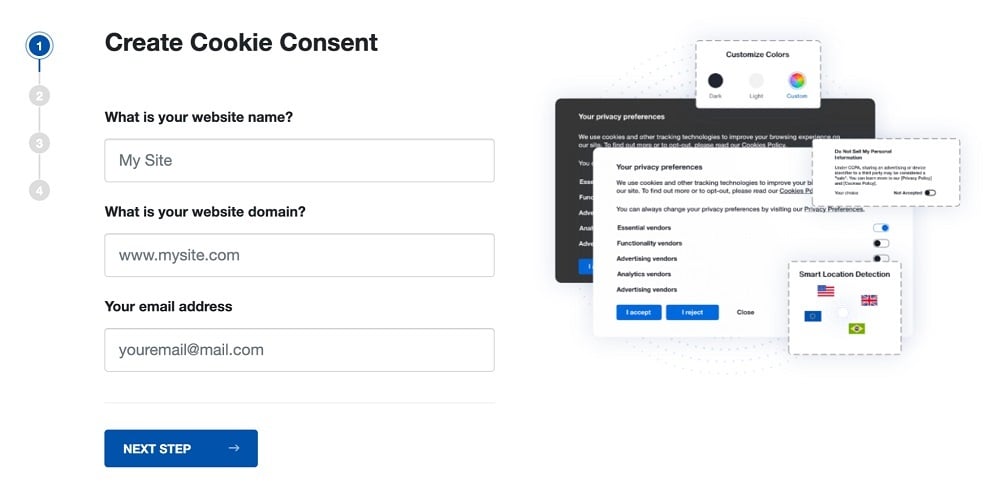
Start the Privacy Consent wizard to create the Cookie Consent code by adding your website information.
-
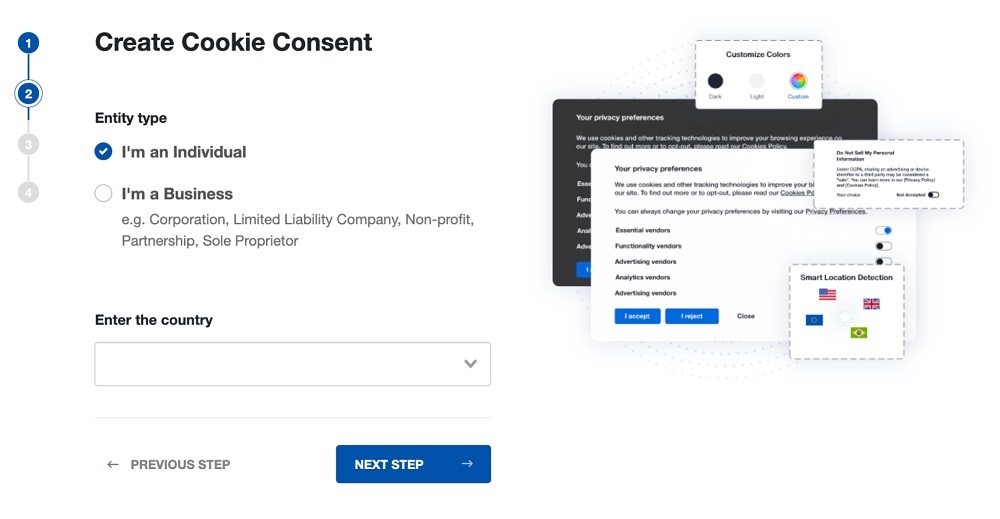
At Step 2, add in information about your business.
-
At Step 3, select a plan for the Cookie Consent.
-
You're done! Your Cookie Consent Banner is ready. Install the Cookie Consent banner on your website:
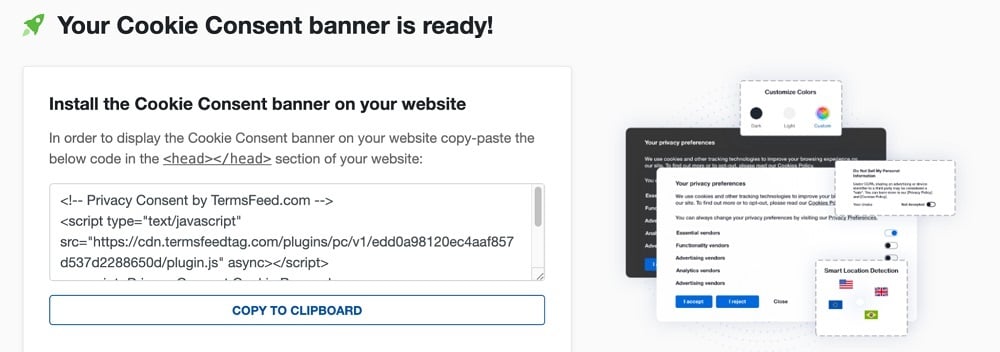
Display the Cookie Consent banner on your website by copy-paste the installation code in the
<head></head>section of your website. Instructions how to add in the code for specific platforms (WordPress, Shopify, Wix and more) are available on the Install page.


- 1. What is Cookiebot?
- 2. What is the Cookiebot Price?
- 2.1. Pricing Tiers for Cookiebot Plans
- 2.2. Is Cookiebot Worth It?
- 3. What are the Best Cookiebot Features?
- 3.1. 1. Patented Automatic Cookie Scanner
- 3.2. 2. Automatic Cookie Blocking (Auto-Blocker)
- 3.3. 3. Google Consent Mode v2 (Gold Tier)
- 3.4. 4. IAB TCF v2.3 Support
- 3.5. 5. Customizable Consent Banner
- 3.6. 6. Geo-Targeting
- 3.7. 7. 47+ Language Auto-Translation
- 3.8. 8. Automated Cookie Declaration Page
- 3.9. 9. Encrypted Consent Logging
- 3.10. 10. Global Privacy Control (GPC) Signal Support
- 3.11. 11. Cross-Domain Consent Sharing
- 3.12. 12. Google Tag Manager Integration
- 3.13. 13. Wide CMS Compatibility
- 3.14. 14. WCAG 2.0 / WAI-ARIA Accessibility
- 3.15. 15. Monthly Scan Reports
- 4. How Does Cookiebot Tool Work?
- 4.1. 1. Prerequisites & Components
- 4.2. 2. Step-by-Step Process Flow
- 4.3. 3. Key Mechanisms Explained
- 4.4. 4. Edge Cases & Failure Modes
- 5. What are the Pros of Cookiebot?
- 6. What are the Cons of Cookiebot?
- 7. What are the Alternatives to Cookiebot?
- 7.1. What is the history of Cookiebot?
What is Cookiebot?
Cookiebot is a cloud-based consent management platform that scans websites for cookies and tracking technologies, controls how they run based on user consent, and records those choices for compliance.
Cookiebot software detects cookies used by your site, categorizes them, and presents this information through a consent banner. It then blocks non-essential cookies until a user gives permission and logs that decision. This setup supports automated compliance with privacy laws such as:
- GDPR (General Data Protection Regulation)
- CCPA (California Consumer Privacy Act)
- EU ePrivacy Directive
- LGPD (Brazilian data protection law)
- POPIA (South African data protection law)
A key characteristic of the Cookiebot tool is its patented scanning technology, which continuously identifies and updates cookies on your site. It pairs this with automatic pre-consent blocking, which ensures tracking does not begin before user approval. Cookiebot merged with Usercentrics in September 2021. The combined entity operates under the Usercentrics name while Cookiebot software lives on as the small and medium-sized business (SMB)-focused product.
The Cookiebot tool allows SMBs to automate cookie compliance without the need for heavy technical setup. Larger organisations typically use the broader Usercentrics platform, which targets enterprise-level privacy management.
What is the Cookiebot Price?
The Cookiebot price is a per-domain subscription model, with plans ranging from a free tier to paid plans from $8 to $96 per month.
Cookiebot pricing depends on site size, not visitor traffic. A website with 500 pages costs more than one with 50 pages, even if the smaller site gets 10 times the traffic. All paid plans include the same core compliance features — the tier you pay for determines how many subpages the scanner covers, not which features you access.
The Free plan is for one domain and up to 50 subpages, with unlimited users. It gives businesses access to:
- GDPR and ePrivacy compliance
- US state regulation compliance
- Google Consent Mode
- Free initial scans
As the screenshot below highlights, the automated configuration system makes it easy for non-technical staff to set up.

All the Premium packages include access to Free tier features, plus the following:
- Personalized Cookiebot banner
- Own logo and branding
- Handling for multiple domains
- Automated reporting
- Multilanguage support
- Banners tailored to regions and countries
This allows businesses to offer a more sleek, tailored look to their visitors.

Pricing Tiers for Cookiebot Plans
| Plan | Cost | Subpages Covered | Observations |
| Free | $0/month | Up to 50 subpages | Basic scanning, consent banner, consent logging |
| Premium Lite | $8/month | Up to 50 subpages | Full features for single small domains |
| Premium Small | $16/month | Up to 350 subpages | Requires 4 or more domains on the account |
| Premium Medium | $34/month | Up to 3,500 subpages | Most common tier for growing sites |
| Premium Large | $56/month | Up to 7,000 subpages | Suited to large content or commerce sites |
| Premium Extra Large | $96/month | More than 7,000 subpages | Highest tier for very large sites |
Cookiebot has 3 structural points that affect long-term cost predictability for SMBs:
- Pricing is per domain: There are no bundled multi-site discounts. Cookiebot bills each domain separately, which adds up quickly for agencies or businesses managing multiple sites.
- Auto-upgrade: The Cookiebot auto-upgrade mechanism moves your plan to the next tier automatically when a scan detects more subpages than your current plan covers, without explicitly seeking approval. This creates the risk of unexpected billing increases.
- Daily scanning add-on: By default, all Cookiebot plans only scan websites once a month. For businesses looking for daily scans, there is an additional €99 (approximately $116) fee per month. This is a significant consideration, as it more than triples the cost of a Premium Medium plan, which costs $34 per month.
- Premium Small limitations: The Premium Small plan is only available at the $16 per month price to accounts with 4 or more domains, following an August 2025 change. Accounts with fewer domains and up to 3,500 subpages must pay $34 per month per domain. Cookiebot reviews have reported users receiving limited advance notice of the change, which occurred back in August 2025.
Is Cookiebot Worth It?
Yes, for some businesses with a small website and a stable page count that need reliable automated scanning and strong Google integration.
However, the pricing model becomes more restrictive and expensive for larger or frequently changing websites, where dynamic content, filter parameters, and archive pages push subpage counts higher than expected. Businesses managing multiple domains benefit from modelling their expected costs before committing to one of the Cookiebot plans.
What are the Best Cookiebot Features?
The best Cookiebot features include cookie scanning, consent management, and compliance tools that automate the detection, control, and documentation of cookies on your website.
Core Cookiebot features include:
- Patented Automatic Cookie Scanner
- Automatic Cookie Blocking (Auto-Blocker)
- Google Consent Mode v2 (Gold Tier)
- IAB TCF v2.3 Support
- Customizable Consent Banner
- Geo-Targeting
- 47+ Language Auto-Translation
- Automated Cookie Declaration Page
- Encrypted Consent Logging
- Global Privacy Control (GPC) Signal Support
- Cross-Domain Consent Sharing
- Google Tag Manager Integration
- Wide CMS Compatibility
- WCAG 2.0 / WAI-ARIA Accessibility
- Monthly Scan Reports
The following breakdown explores what each feature does, why it's valuable, and how users benefit from it.
1. Patented Automatic Cookie Scanner
Patented Automatic Cookie Scanner is a tool that simulates real user visits across your site to detect and categorize cookies and tracking technologies automatically, with no manual work required.
The scanner crawls subpages and identifies more than 10 tracking types, including HTTP cookies, JavaScript cookies, Local Storage, IndexedDB, pixel tags, and web beacons. It runs like a real browser session, which allows it to catch trackers loaded through dynamic content, iframes, and embedded tools. Cookiebot states that it cross-references results against a database of 13,000+ known trackers, thereby improving classification accuracy.
Imagine a scenario in which a marketing team embeds a YouTube video on a landing page. The embed introduces Google tracking cookies that the site owner never configured directly. The scanner detects and categorizes them automatically, adding them to the cookie declaration without any manual intervention.
Scanning runs monthly by default. As the snippet below shows, Cookiebot offers daily scanning as a €99 per month add-on. The plan tier determines how many subpages the scanner covers, and Cookiebot automatically upgrades the subscription when page counts exceed the current limit.

2. Automatic Cookie Blocking (Auto-Blocker)
Automatic Cookie Blocking (Auto-Blocker) is a system that intercepts scripts at the Document Object Model (DOM) level. This means it stops code from executing in the browser before the page fully loads, preventing non-essential cookies, iframes, and tracking elements from running before a user gives consent.
It applies a known-tracker checklist, a pre-built list of recognized third-party services, to block common tools automatically. Google Analytics, Facebook Pixel, and YouTube embeds are all blocked until the user grants explicit consent, and there is no need for manual script modifications.
Consider a scenario in which a visitor lands on a site before accepting cookies. Without the Auto-Blocker, Google Analytics fires immediately and begins collecting data. With it enabled, the script stays dormant until the visitor makes an active choice.
Under GDPR Article 7, shown below, consent must precede data collection. Displaying a banner without blocking scripts means trackers run regardless of what the user chooses, making the banner decorative rather than legally effective. The Auto-Blocker closes that gap.

All paid plans include the Auto-Blocker feature; the free tier offers limited functionality.
3. Google Consent Mode v2 (Gold Tier)
Google Consent Mode v2 (Gold Tier) is a tool that automatically sends consent signals to Google Analytics 4 and Google Ads based on the choices of each user, switching between full tracking and cookieless measurement in real time.
Cookieless measurement uses Google machine learning to estimate campaign performance when a user declines consent, preserving conversion modeling without relying on personal tracking data.
Here is what this looks like in practice. An EU visitor declines marketing cookies. Cookiebot immediately signals Google Ads to switch to restricted mode. The machine learning technology from Google fills the data gap, allowing the business to retain campaign performance estimates without collecting personal data.
Cookiebot holds Gold Tier status in the CMP Partner Program of Google, the highest of 3 certification levels. Google requires this certification to run personalised Google Ads campaigns targeting EEA users following its March 2024 enforcement rules. Without it, Google restricts ad delivery and conversion tracking for EEA traffic entirely.
All Cookiebot plans include Google Consent Mode v2.
4. IAB TCF v2.3 Support
IAB TCF v2.3 Support is the feature in the Cookiebot software that enables it to operate as a registered consent management platform under the IAB TCF. The IAB (Interactive Advertising Bureau) is the industry body that governs digital advertising standards, and the TCF (Transparency and Consent Framework) is its technical system that standardizes the collection, recording, and sharing of user consent across the digital advertising supply chain. Its goal is to ensure that every party involved in serving an ad to a user knows whether that user has agreed to the collection and use of their data.
Cookiebot holds IAB Europe certification under CMP ID 134. It generates a consent string and a coded record of user choices. It shares this automatically with ad vendors, SSPs (Supply-Side Platforms, the technology publishers use to sell ad inventory), and platforms such as Google Ad Manager.
In the real world, a news website running header bidding, where multiple ad buyers compete simultaneously for each page impression, requires every demand partner in that auction to receive a valid consent signal before processing user data. Without a TCF-registered CMP, those partners cannot legally bid on EU traffic. This reduces auction competition and directly lowers ad revenue. A publisher using Google Ad Manager faces the same constraint: Google requires a valid TC string to serve personalised ads to EEA users.
Cookiebot TCF support includes Google Additional Consent Mode, which covers ad tech vendors not yet listed on the IAB Global Vendor List, extending compatibility beyond the core framework. All Cookiebot plans support IAB TCF v2.3.
5. Customizable Consent Banner
Customizable Consent Banner is the Cookiebot feature that gives you full control over the design, content, placement, and behavior of your Cookie Consent Notice. This allows it to match your brand without requiring custom development.
Options include colors, fonts, layout, and text, with format choices covering bottom bars, center popups, side panels, and dialog overlays. Content adjusts per language, and trigger conditions — the rules that determine when and how the banner appears, such as on first visit or after a set delay — are configurable to balance user experience with consent collection.
As Cookiebot states in the excerpt below, its patented scanner helps keep cookie banners up to date. This matters because under GDPR, consent obtained through a misleading or unclear banner is not valid consent. A banner that fails to meet current regulatory standards exposes the business to the same legal risk as having no banner at all.

In practice, this allows a retail brand operating across Germany, France, and Japan to automatically serve each visitor a banner in their browser language, with consistent brand colors and button styling throughout, without managing separate implementations for each region.
The free plan includes only a standard color scheme and does not support multi-language banners, logo addition, or custom banner templates. All paid plans offer full customization.
6. Geo-Targeting
Geo-Targeting is the feature in the Cookiebot software that automatically adjusts consent banner behavior based on the geographic location of each visitor, applying the correct compliance rules for their region without requiring separate implementations.
Privacy laws differ significantly by jurisdiction. The GDPR (General Data Protection Regulation) requires strict opt-in consent from EU visitors. The CCPA (California Consumer Privacy Act) requires disclosure and opt-out rights for California residents. Many other regions have no requirements at all. Applying a single global approach risks either over-collecting consent where it is not needed or under-collecting it where it is legally required.
Geo-Targeting lets businesses target different jurisdictions more accurately. An EU visitor sees a full opt-in banner requiring an active choice before any non-essential cookies load. A visitor from a region with no applicable law sees either a simplified notice or no banner at all, depending on configuration.
Targeting works at both the country and state levels in the United States. As shown below, a business serving US visitors targets California specifically, displaying a CCPA-compliant notice to California residents while showing a different banner to the rest of the US.

Geo-targeting is a paid feature, available on all plans from Premium Lite upward. It is not available on the free plan.
7. 47+ Language Auto-Translation
The 47+ Language Auto-Translation feature is a Cookiebot capability that detects the browser language of each visitor and displays the consent banner in that language from a library of 47+ translations.
The Cookiebot 47+ language auto-translation system automatically switches the banner language based on user settings, without requiring manual configuration for each region. Users control it further through URL structures or tag manager variables, which allows more precise targeting where needed.
This matters because many privacy laws require clear communication in a language the user understands. Managing translations manually across multiple regions increases complexity and risk of inconsistency. Users benefit from a consent experience in their preferred language, which improves clarity and usability. Businesses benefit from covering multilingual compliance requirements without ongoing translation work.
Examples include a German visitor seeing a German banner and a Japanese visitor seeing a Japanese version automatically. Multi-language support and automatic language detection require a paid plan. Cookiebot includes both features across all paid plans from Premium Lite upward.
8. Automated Cookie Declaration Page
Automated Cookie Declaration Page is a tool in the Cookiebot software that generates a dynamic, embeddable list of all detected cookies, including the purpose, duration, provider, and current consent status of each cookie, updating automatically after every scan.
Many privacy regulations require businesses to maintain a clear, publicly accessible record of the cookies their site uses. Maintaining this list manually creates an ongoing risk: every new plugin, ad script, or embedded tool potentially introduces new cookies, and a static list goes out of date quickly. Cookiebot aims to remove that risk by pulling the declaration directly from its scanner data, so the list always reflects what the most recent scan found.
This means that if a marketing team installs a new analytics tool mid-month, the next monthly scan detects the new cookies automatically, and the declaration updates without any manual intervention. The business retains an accurate, compliant public record without anyone reviewing or editing it. The declaration embeds directly into any existing Privacy Policy or Cookie Policy page using a JavaScript snippet, sitting alongside existing policy text rather than requiring a separate page.
Both the free plan and all paid plans include the standard Cookie Declaration. Custom declaration styling using XSLT requires a paid plan.
Standard plans scan monthly by default, which means cookies introduced by new plugins or scripts between scans are absent from the declaration until the next scan runs. Daily scanning, which costs €99 per month, reduces that gap. Cookiebot automatically upgrades your subscription to the next tier to maintain full coverage when the scanner detects more subpages than your current plan covers. This keeps the declaration accurate but increases your monthly cost without explicit approval.
9. Encrypted Consent Logging
Encrypted Consent Logging is the feature in the Cookiebot software that automatically records every consent interaction server-side with SSL encryption, capturing a timestamp, anonymized IP address, browser details, the URL from which the visitor submitted consent, and the specific choices made.
GDPR Article 7 places the burden of proof of consent on the business, not the regulator. Cookiebot meets this requirement without storing personally identifiable information, using anonymized IP addresses and random encrypted keys instead.
Consider a practical example – a Data Protection Authority opens an investigation and requests proof of consent. The business exports timestamped, anonymized records directly from the Cookiebot dashboard for any selected domain and time period, evidencing compliance.
Both the free plan and all paid plans include the consent log. Consent statistics showing opt-in and opt-out rates over time require a paid plan.
10. Global Privacy Control (GPC) Signal Support
Global Privacy Control (GPC) Signal Support is a feature in the Cookiebot software that detects and automatically honors browser-level opt-out signals sent under the GPC specification, without requiring any action from the visitor on the consent banner.
GPC is a browser-level privacy standard that lets users set a single opt-out preference across all participating websites. The CCPA and CPRA (California Privacy Rights Act) both recognize it as a legally valid opt-out mechanism.
For example, a California resident uses Brave or Firefox with GPC enabled. Cookiebot reads the signal on page load and automatically applies an opt-out state, overriding any pre-checked consent categories, with no banner interaction needed.
As shown below, GPC support applies to specific banner types only — Decline Only, Do Not Sell, and Multilevel — and has no impact on other configurations. As more browsers adopt GPC natively, this feature reduces the need for ongoing compliance adjustments to US state privacy laws.

11. Cross-Domain Consent Sharing
Cross-Domain Consent Sharing is a part of the Cookiebot software that allows the consent choice of each visitor to apply automatically across multiple domains and subdomains within the same organization, so the visitor only sees the consent banner once.
By default, Cookiebot asks for consent separately on each domain. With Cross-Domain Consent Sharing enabled, a visitor who consents on one property carries that choice across all connected domains in the same Domain Group, without seeing the banner again until consent expires.
Here is what this looks like in practice – a retail brand runs separate domains for its online store, blog, and customer support center. A visitor consents on the store site, then navigates to the blog. The banner does not reappear. Their preferences apply immediately across all 3 properties.
It is important to note that this feature relies on third-party cookies in the browser of each visitor. Users with third-party cookies blocked will not benefit from shared consent.
Cross-Domain Consent Sharing requires a paid plan and is not available on the free plan. Each domain within the group still requires its own Cookiebot subscription, so costs scale per domain even though consent settings apply across the board.
12. Google Tag Manager Integration
Google Tag Manager (GTM) Integration is the feature in the Cookiebot software that allows marketing teams to deploy the consent banner, configure consent categories, and control tag-firing rules entirely within GTM, without making direct code changes to the website.
GTM is a tag management system, meaning it gives non-developers a central dashboard to control which tracking scripts run on a website and when. Cookiebot integrates directly into that workflow, supporting auto-blocking inside the GTM container so that tags such as Google Analytics and Facebook Pixel only fire after the visitor has given the correct consent.
Imagine a scenario in which a marketing team wants to add a new advertising pixel. Without this integration, a developer has to add and configure it in the site code. With GTM, the marketer deploys the tag, links it to the appropriate Cookiebot consent category, and publishes, with no code change required. The pixel fires only after a visitor consents to marketing cookies.
All Cookiebot plans include GTM integration, including the free plan.
13. Wide CMS Compatibility
Wide CMS Compatibility is a part of the Cookiebot software that allows it to deploy across major content management systems (CMS) — the platforms businesses use to build and manage websites — through dedicated plugins and apps, without requiring custom development.
Cookiebot offers native integrations for WordPress, Shopify, Squarespace, Wix, Magento, and Drupal, alongside a standalone JavaScript script for custom-coded sites. This means a business running WordPress for its main site and Shopify for its store applies the same consent system across both, without rebuilding the setup for each platform.
A WordPress site owner installs the Cookiebot plugin directly from the WordPress plugin directory, enters their Domain Group ID in the settings panel, and the banner is live within minutes. It requires no code editing.
One practical limitation worth noting for WordPress users is that performance and caching plugins, such as LiteSpeed Cache, WP Rocket, and Cloudflare Rocket Loader, interfere with the Cookiebot auto-blocking tool by deferring or minifying its script. This requires manual exclusion configuration within those plugins and does not affect standalone script installations.
All plans include CMS compatibility. Subscription tiers and per-domain pricing apply regardless of which platform the site runs on.
14. WCAG 2.0 / WAI-ARIA Accessibility
WCAG 2.0 / WAI-ARIA Accessibility is a Cookiebot feature that ensures the Consent Banner meets W3C Web Content Accessibility Guidelines 2.0 and WAI-ARIA standards, allowing users who rely on assistive technologies to interact with consent choices fully and independently.
The W3C (World Wide Web Consortium) publishes WCAG (Web Content Accessibility Guidelines), the international standard that defines how developers structure web content to serve users with disabilities. WAI-ARIA (Accessible Rich Internet Applications) is a companion specification that adds semantic markup so assistive technologies interpret interactive elements correctly.
This matters for businesses because inaccessible consent banners create both a legal and a practical risk. A user who cannot interact with the banner cannot give or withhold consent, which undermines the validity of the consent process entirely. Businesses with inaccessible consent tools face growing exposure to accessibility litigation, particularly in the US under the Americans with Disabilities Act (ADA).
This means that a visually impaired visitor using a screen reader who lands on a website running Cookiebot uses accessible tools to give consent. The reader announces the consent banner, describes each category, and allows the visitor to navigate and submit their choices using keyboard controls alone, without a mouse. A keyboard-only user tabs through the same options and submits their choice without needing a pointer device.
Cookiebot builds accessibility support into the core product and includes it across all plans.
15. Monthly Scan Reports
Monthly Scan Reports is the feature in the Cookiebot software that automatically sends an email after each scan detailing newly detected cookies, removed cookies, changed sources, and updates to third-party data sharing, so teams stay informed about tracker changes without logging into the dashboard.
Tracking environments change constantly. A developer installs a new plugin, a marketing team adds an ad tag, or an embedded video player updates its scripts. Each of these actions introduces new cookies that were not previously disclosed.
Here is what this looks like in practice. A marketing team installs a new analytics plugin. The next monthly scan detects the cookies it sets and emails the report automatically. The team reviews, categorises, and updates the consent banner without manually auditing the site.
Monthly scanning is the default across all plans. The free plan delivers reports to the account owner only. As shown below, paid plans allow multiple email recipients. Cookiebot offers daily scanning as a €99 per month add-on, which reduces the detection gap to 24 hours.

How Does Cookiebot Tool Work?
The Cookiebot tool works by installing a JavaScript snippet in the head section of your website, before any tracking scripts, which then scans for cookies, blocks non-essential tracking before consent, displays a geo-targeted banner, and stores consent decisions securely.
The core process works as follows:
- Add the script to the head section before any tracking code, without defer or async attributes
- The scanner crawls all subpages, simulating approximately 5 concurrent user sessions to detect cookies across dynamic content
- Cookiebot categorises detected cookies against its database of 13,000+ known trackers and generates a configuration file automatically
- The geo-targeting engine adjusts the consent banner behavior based on the geographic location of each visitor
- The Auto-Blocker enforces user choices by intercepting DOM injections, stopping scripts, iframes, and pixels from executing before users give consent
- Encrypted logging captures every consent decision, and the scanner re-crawls the site monthly
1. Prerequisites & Components
Prerequisites and components require a JavaScript snippet added to the head section of your website before any tracking code, without defer or async attributes, as the foundation for all scanning, blocking, and consent functions to operate correctly.
Once active, the system relies on 4 connected components:
- Cookie scanner
- Consent banner
- Auto-Blocker
- Encrypted consent log
Each depends on correct script implementation to function.
Pricing directly affects how completely these components perform. Monthly scanning is the default across all plans, meaning new trackers introduced between scans go undetected until the next cycle. Daily scanning reduces that gap but adds €99 per month to the cost.
Each domain requires its own subscription. The August 2025 pricing restructure increased base costs significantly, and the auto-tier upgrade mechanism raises costs further whenever the scanner detects additional subpages.
2. Step-by-Step Process Flow
Setting up Cookiebot requires a website, a Cookiebot account, and a registered domain within the platform. The scope of what follows depends directly on the plan selected.
The setup process works as follows:
- Add the Cookiebot JavaScript snippet to the head section of your site before any tracking code, without defer or async attributes
- Wait for the initial scan, which typically completes within 24 hours
- Review the automatically generated cookie categories based on detected trackers
- Customize the consent banner, including layout, language, geo-targeting rules, and GTM configuration
- Test that non-essential cookies do not load before consent and verify that consent decisions appear in the log
- Publish the banner live
The initial scan only covers the subpages your plan allows, which determines how complete the setup is from day one. Each domain requires a separate subscription, and the August 2025 pricing restructure means those costs are higher than many existing users' budgeted for.
3. Key Mechanisms Explained
The Cookiebot software operates through 3 linked mechanisms that handle detection, enforcement, and documentation.
The scanner simulates real user visits across your site and compares results against the Cookiebot tool database of 13,000+ known trackers, assigning categories automatically. The Auto-Blocker intercepts DOM injections, preventing non-essential scripts, iframes, and pixels from executing before a visitor gives consent. Encrypted logging captures every consent decision with a timestamp and anonymized identifier, creating an audit-ready record.
Each mechanism depends on the plan in place. The scanner covers only the subpages your tier allows, which means your plan directly determines detection coverage. Monthly scanning runs as standard across all plans, so new trackers introduced between scans go unrecorded until the next cycle. Closing that gap costs an additional €99 per month for daily scanning.
Per-domain pricing means every site in a multi-domain environment carries its own subscription cost. The auto-tier upgrade mechanism increases the cost automatically when page counts grow.
4. Edge Cases & Failure Modes
Edge Cases & Failure Modes in the Cookiebot software include the potential to fail to detect, block, or correctly apply consent in specific situations, and user reviews across multiple platforms identify some recurring patterns.
Some reviewers note that the scanner overcounts pages in some cases, detecting more subpages than the site actually contains. This issue has triggered automatic tier upgrades and unexpected cost increases without any change to the actual site.
Performance issues surface on WordPress sites specifically. Caching and optimisation plugins such as LiteSpeed and WP Rocket conflict with the Cookiebot script and break auto-blocking if not manually excluded.
What are the Pros of Cookiebot?
The pros of Cookiebot are its set of scanning, consent management, and compliance capabilities that reduce manual work, automate legal requirements, and integrate reliably with major advertising and analytics platforms.
Reviewers consistently praise the following:
- Fast and Easy Setup: Cookiebot installs via a single JavaScript snippet or CMS plugin, with most sites going live within minutes and no developer required for standard configurations.
- Effective Automatic Cookie Scanning: The scanner simulates real user sessions across all subpages, cross-referencing results against a database of 13,000+ known trackers — as stated by Cookiebot — without any manual auditing needed.
- Best-in-Class Google Integration (Gold Tier CMP): Cookiebot holds Gold Tier status in the CMP Partner Program of Google, the highest of 3 certification levels. Google requires this certification to run personalised Google Ads campaigns targeting EEA users, following its March 2024 enforcement rules.
- Functional Free Tier: The free plan includes the cookie scanner, consent banner, consent log, and Google Consent Mode v2 for a single domain with up to 50 subpages.
- Automated Compliance Updates: Cookiebot updates default banner configurations reactively when specific regulatory requirements change, reducing the need for businesses to monitor shifting requirements themselves.
- Good Banner Customization: Colors, fonts, layout, positioning, and per-language text are all adjustable across multiple banner formats without custom development on all paid plans.
- Geo-Targeting by Visitor Location: A single implementation automatically serves region-appropriate consent experiences down to the country and state level, covering GDPR requirements for EU visitors and CCPA requirements for California residents from one setup.
- Broad Language Support (47+ Languages): The banner detects browser language and switches automatically, covering multilingual compliance requirements without ongoing translation work on all paid plans from Premium Lite upward.
- Audit-Ready Encrypted Consent Logs: Cookiebot records every consent interaction server-side with SSL encryption, providing exportable proof of consent for GDPR Article 7 compliance without storing personally identifiable information.
- Confirmed Pre-Consent Blocking Effectiveness: The Auto-Blocker intercepts DOM injections, enforcing genuine pre-consent compliance rather than just displaying a banner, in line with the requirement of GDPR Article 7 that consent precede data collection.
- Comprehensive Tracker Detection Beyond Cookies: The scanner identifies more than 10 tracking technology types, including HTTP cookies, JavaScript cookies, Local Storage, IndexedDB, pixel tags, and web beacons, improving visibility of data collection across modern site architectures.
- Wide Platform Support: Native plugins cover WordPress, Shopify, Squarespace, Wix, Magento, and Drupal, alongside a standalone script for custom-coded sites, allowing consistent consent management deployment regardless of the underlying technology stack.
- Helpful Documentation and Video Guides: Cookiebot maintains an extensive support library covering installation, configuration, and troubleshooting across all major platforms, with implementation guides that users consistently describe as clear and straightforward.
- Handles Dynamic Content and Embedded Media: The scanner runs like a real browser session, catching trackers loaded through dynamic content, iframes, and embedded tools such as YouTube embeds and social media widgets that site owners haven't directly configured.
- IAB TCF v2.3 Support for Publishers: IAB Europe registers Cookiebot as a certified CMP under ID 134, enabling it to generate and pass compliant consent strings to ad vendors and SSPs, allowing publishers to maintain programmatic ad revenue while meeting GDPR requirements.
- WCAG 2.0 / WAI-ARIA Accessibility Compliance: The consent banner meets WCAG 2.0 standards and supports WAI-ARIA markup, allowing users who rely on screen readers and keyboard navigation to interact with consent choices fully and independently, reducing accessibility litigation risk and demonstrating inclusive design standards.
What are the Cons of Cookiebot?
The cons of Cookiebot are a set of cost, usability, and technical limitations that become more significant as website size and complexity increase.
In reviews, users often complain about the following Cookiebot limitations:
- Significant 2025 Price Increase with Poor Communication: Base costs increased sharply in August 2025, with many users reporting they received inadequate advance notice. Some accounts experienced cost increases of close to 10 times their previous subscription.
- Expensive Compared to Competitors: The per-domain, subpage-based pricing model frequently produces higher costs than traffic-based alternatives. At current rates, comparable tools charge significantly less for equivalent functionality.
- Automatic Tier Upgrades Causing Surprise Bills: Cookiebot automatically upgrades subscriptions when the scanner detects more subpages than the current plan covers, without explicit approval. This creates unpredictable monthly costs for growing or frequently updated sites.
- Email-Only Customer Support: Support operates through email and ticketing only. Users dealing with urgent compliance issues, such as cookies firing before consent, report slow response times with real business impact.
- Monthly-Only Default Scan Frequency: New trackers introduced between scans go undetected until the next cycle. Closing that gap requires a €99 per month daily scanning add-on.
- Website Performance Impact on Core Web Vitals: The consent script potentially affects page load performance, particularly on script-heavy sites, which risks impacting SEO and user experience.
- Unintuitive Admin Interface: Multiple users report difficulty navigating cookie categorization and understanding the relationship between Cookiebot and Usercentrics.
- Limited Reporting and Analytics: Reporting focuses on basic scan results and consent logs, providing limited insight into consent behavior trends, opt-in rate optimization, or comparative analytics across domains.
- Subpage Count Inflation: Users report the scanner detecting significantly more pages than the site contains, triggering automatic tier upgrades and additional costs.
- Post-Cancellation Billing Issues: A recurring theme in user reviews describes billing continuing after account cancellation, with users reporting difficulty obtaining refunds and poor support responsiveness when raising the issue.
- Outdated Support Documentation: Some support articles do not reflect the current interface or feature set, particularly following the August 2025 pricing restructure and the ongoing Usercentrics rebrand, which slows troubleshooting and increases misconfiguration risk.
- Limited Design Customization Without Custom CSS: Advanced visual control requires CSS knowledge, adding complexity for teams without development resources.
- Integration Issues with Certain Platforms: Some setups involving complex tag stacks, custom scripts, or less common CMS configurations require additional manual configuration, with standard documentation not covering non-standard environments adequately.
- WordPress Plugin Limitations: The plugin simplifies setup but conflicts with common caching and optimization tools such as LiteSpeed and WP Rocket, requiring manual exclusion configuration to maintain auto-blocking functionality.
What are the Alternatives to Cookiebot?
The alternatives to Cookiebot are a mix of consent management platforms, legal compliance tools, and enterprise privacy solutions that offer different pricing models, feature depth, and levels of control.
The most popular Cookiebot competitors include:
- TermsFeed: An all-in-one alternative to Cookiebot, combining consent management with automated generation of Privacy Policies, Terms and Conditions, and Cookie Policies in a single platform. Best for SMBs that want complete compliance coverage without managing multiple tools.
- CookieYes: Similar CMP functionality to Cookiebot with traffic-based pricing, making costs more predictable for growing sites.
- OneTrust: Enterprise-grade platform with advanced governance and automation, best for large organisations managing complex regulatory requirements.
- iubenda: Combines policy generation with consent management, suited to businesses prioritising ongoing legal maintenance.
- Termly: Simple policy generators and consent banners at straightforward pricing, ideal for smaller businesses needing an easy entry point.
- Osano: Pairs consent management with vendor monitoring, useful for businesses needing broader privacy oversight.
- CookieScript: Flexible pricing with strong customisation, good for businesses needing more control without enterprise complexity.
- Didomi: Focuses on consent optimisation and user experience, best for brands prioritising conversion rates alongside compliance.
- ConsentManager: Strong multi-regulation and integration support, useful for international businesses.
- TrustArc: Enterprise compliance automation with risk management, best for regulated industries.
- Complianz: WordPress-focused plugin with region-specific compliance features, ideal for WordPress users.
- Quantcast Choice: Free CMP with strong advertising ecosystem support, useful for publishers and ad-driven sites.
- Cookie Information: European-focused CMP with strong GDPR alignment, good for EU-based businesses.
- Borlabs Cookie: Premium WordPress plugin with granular script control, suited to developers and advanced users.
- CookieFirst: Automated scanning and compliance tools comparable to Cookiebot for standard use cases.
- Ketch: Advanced consent and data governance platform, best for enterprises managing complex data ecosystems.
- Pandectes: Shopify-focused consent solution, ideal for ecommerce brands on Shopify.
- Axeptio: User-friendly consent flows with strong design focus, good for brands prioritising UX.
- Securiti.ai: Enterprise platform covering data privacy, security, and governance at scale.
- Piwik PRO: Combines analytics with privacy controls, useful for organisations wanting greater control over data collection.
What is the history of Cookiebot?
The history of Cookiebot traces back to early EU cookie compliance, growing from a single-purpose compliance tool into one of the most widely used consent management platforms in the world.
Key milestones in the history of the Cookiebot tool include:
- 2012: Daniel Johannsen founds Cybot in Copenhagen to address EU Cookie Directive requirements, making Cookiebot one of the longest-running dedicated CMPs available.
- 2017: Johannsen, Mischa Rurup, and Lisa Gradow co-found Usercentrics GmbH in Munich, expanding into broader privacy compliance.
- 2021: Cybot and Usercentrics unite on September 8, with Cookiebot continuing as the SMB-focused product.
- 2025: A major pricing restructure in August reshapes costs significantly for existing customers.
- 2026: Cookiebot ranks number 1 CMP in the G2 Best Software Awards.
According to Usercentrics, the Cookiebot now serves over 2.4 million websites and processes over 8 billion user consents monthly.

The first step to compliance: A Privacy Policy.
Stay compliant with our agreements, policies, and consent banners — everything you need, all in one place.


